
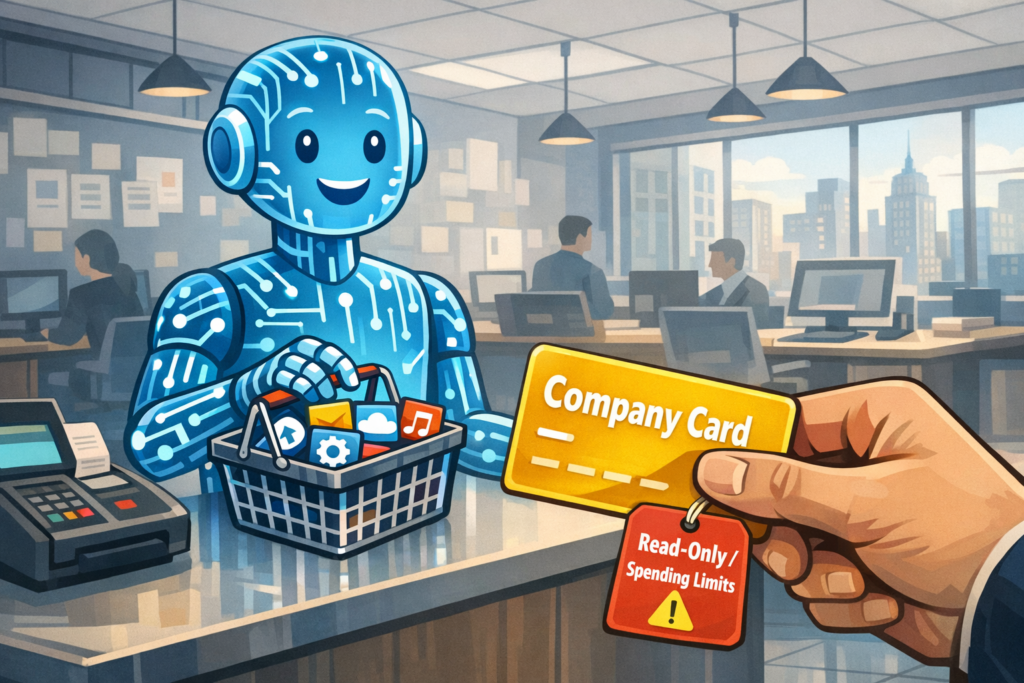
The moment AI agents moved from chat windows into the real world was inevitable: once models could plan, act and carry out multi-step tasks autonomously, the obvious next step was letting them handle our mundane chores — booking flights, managing subscriptions, paying invoices. That convenience is real and immediate. But handing a digital assistant the keys to your wallet is a different proposition from letting it suggest which headphones to buy.
Autonomy meets money: why things get complicated fast
AI agents are not simply smarter chatbots. They maintain state, chain together actions, talk to APIs, and—crucially—can be configured to perform transactions on behalf of users. That opens a market for seamless commerce and automation: the agent that shops for you and checks out, the agent that negotiates contracts and pays vendors, the agent that hunts down better insurance and flips your plan when it finds one.
But money changes the threat model. Human users can revoke a credit card or dispute a charge; agents can run at machine speed, execute many small transactions, and be manipulated by malicious prompts or compromised integrations. When authorization boundaries are unclear, the same technology that cancels subscription clutter can also empty your account.
The fundamental tension: convenience vs. control
Consumers crave frictionless experiences. Merchants, payment platforms, and AI companies see massive value in reducing checkout abandonment and offering “one-click” agent-driven purchases. Yet each layer of convenience tends to erode explicit, contextual consent. Giving an agent a long-lived billing authority is functionally equivalent to delegating financial decision-making—and most current systems were not designed for that kind of delegation.
Where the risks concentrate
The vulnerabilities fall into several overlapping categories:
- Credential and token abuse. Storing card credentials or long-lived payment tokens with third-party agents creates a target for credential stuffing, supply-chain compromise, or exfiltration.
- Authority creep. An agent granted permission to “order office supplies” can escalate that authority via vague intent recognition or through malicious reconfiguration.
- Hallucination-driven actions. LLMs can be confidently wrong. If an agent misinterprets a user instruction and submits a payment, the financial harm is real even if the mistake was unintentional.
- Social-engineering exploitation. Voice clones, forged messages, or compromised devices can trick an agent into approving transactions unless strong, multi-channel verification is in place.
- Chargebacks and liability. Merchants will see increased disputes if agents make unauthorized purchases, and ecosystems lack clear rules about who pays when delegation goes wrong.
Strategic context: players, incentives, and emergent markets
Several forces are pushing AI agents into payments. AI-platform providers want to increase user engagement and create monetizable features. Payment processors and fintechs crave conversions and hooks into new commerce flows. Merchants want higher conversion rates and subscription retention. And consumers want convenience.
This convergence creates a new competitive layer: agent marketplaces and “agent-enabled commerce.” Imagine an ecosystem where independent developers publish specialized agents—travel-booking agents, tax-filing agents, medical-billing agents—that users can grant scoped permissions to act. Each agent could carry monetization models (commissions, subscription fees, revenue sharing) and negotiate on pricing in real time.
That vision will be attractive to startups and legacy incumbents alike, but it amplifies friction points. Payment companies will need to decide if they allow long-lived agent tokens, and regulators will scrutinize how consumer protections apply when machines, not people, are making purchases.
Technical and policy controls that should be standard
Not all risk is inevitable. A combination of engineering best practices, new standards, and sensible regulation can preserve much of the consumer upside while limiting damage.
- Least-privilege, time-limited tokens. Agents should receive narrowly scoped payment capabilities: per-merchant tokens, capped amounts, and expiration windows. Token design (capability-based macaroons or scoped OAuth variants) is key.
- Per-transaction authentication. High-value or unusual transactions should require an out-of-band confirmation—push notification, biometric on-device confirmation, or an SMS/secure call—rather than silent approval.
- Human-in-the-loop thresholds. Designers should default to requiring human sign-off for recurring subscriptions, changes to payout accounts, or transfers beyond a user-set threshold.
- Transparent audit trails. Every agent action needs a clear, immutable record: what was requested, why the agent acted, which information it used, and how the user authorized the step.
- Easy revocation and “kill switches.” Users must be able to instantly revoke an agent’s financial privileges from multiple places (bank app, card issuer, agent dashboard) and freeze new transactions.
- Verifiable identity and attestations. Agents should carry attestations about their provenance and allowed capabilities—machine-readable credentials that platforms can check before accepting instructions.
Payment infrastructure will evolve
We should expect payment networks and processors to introduce agent-aware controls. Tokenization providers may offer “agent tokens” that can be constrained to merchant categories, spend caps, and time windows. Banks and issuers could provide dashboards that show agent activity and enable instant disputes with reduced friction for consumers. These are engineering problems, but they require commercial alignment and standards work.
Regulatory and liability questions on the horizon
Existing consumer-protection regimes were written with human actors in mind. Delegated machine actions raise new legal questions: who is responsible when an autonomous agent misuses delegated authority—its developer, the platform hosting it, the payment provider, or the user?
Regulators will likely focus on a few priorities:
- Ensuring consumers receive clear disclosure and affirmative consent mechanisms before an agent can make payments.
- Defining liability regimes for unauthorized agent-initiated transactions, including faster dispute resolution and mandatory reimbursement standards.
- Requiring strong authentication standards for agent authorization, aligned with frameworks like PSD2’s SCA in Europe and comparable rules elsewhere.
- Mandating transparency about agent provenance and capabilities so users can make informed decisions about delegation.
Absent regulatory clarity, platforms will set the de facto rules—and those rules will likely prioritize growth unless checked by lawmakers or competition.
Real-world scenarios that illustrate the stakes
Consider three plausible stories:
A helpful agent, a costly mistake
A user commands their personal agent to “rebook my trip if prices drop.” The agent monitors fares and, seeing a small drop, rebooks multiple connected travelers without confirming, incurring change fees and different flight routings. The user disputes the charges; the merchant points to the tokenized payment authorization and the agent’s consent log. Neither party is clearly on the hook, and the resolution is slow and painful.
Subscription proliferation
Another agent aggressively optimizes subscriptions across dozens of services. It signs the user up for free trials and then auto-renews the best options. The user loses track of recurring payments, gets hit with overlapping annual renewals, and faces uphill battles getting refunds because the agent’s consent model was broadly phrased.
Business automation exploited
On the enterprise side, an accounts-payable agent with wide bank access is tricked into authorizing a vendor change via a spear-phishing campaign that uses deepfake audio of an executive. Funds are wired to an attacker-controlled account before the fraud is detected. The company faces not only financial loss but regulatory scrutiny for weak controls.
Practical advice for builders and buyers of agents
If you build AI agents that may touch payments, design for the worst-case attack surface. Assume they will be probed and abused. If you buy or use such agents, don’t hand over unrestricted card privileges.
- Designers: enforce capability-based authorization, require per-transaction confirmation for risky actions, and instrument detailed, tamper-evident logs.
- Payment providers: offer agent-scoped tokens, merchant-category limits, and standardized attestation APIs so platforms can verify agent claims.
- Regulators and standards bodies: accelerate guidance around agent authorization, liability assignment, and mandatory consumer protections.
- Consumers: prefer agents that operate with limited scopes, visible audit logs, and easy revocation controls. Never store long-lived, unrestricted payment credentials with an agent you don’t fully control.
Where this goes next
Agent-driven commerce is not a fad. The productivity gains are enormous and will reshape workflows across consumer and enterprise spaces. But the interplay between autonomous decision-making and financial authority will be decisive in shaping winners and losers. Companies that build trust-preserving agent architectures—combining ephemeral tokens, strong attestation, human-in-the-loop controls, and clear liability provisions—will earn adoption. Those that prioritize growth through frictionless payments without robust safeguards will face regulatory backlash and reputational harm.
The core insight is simple: AI agents are powerful because they can act for us, not just tell us what to do. That power demands a rethinking of authorization, accountability, and design defaults. Treat the agent as a new kind of intermediary—a hybrid legal and technical actor whose actions must be constrained, logged, and reversible. Until the ecosystem matures, the prudent default is also simple: convenience, yes — but don’t give agents carte blanche access to your credit card.