
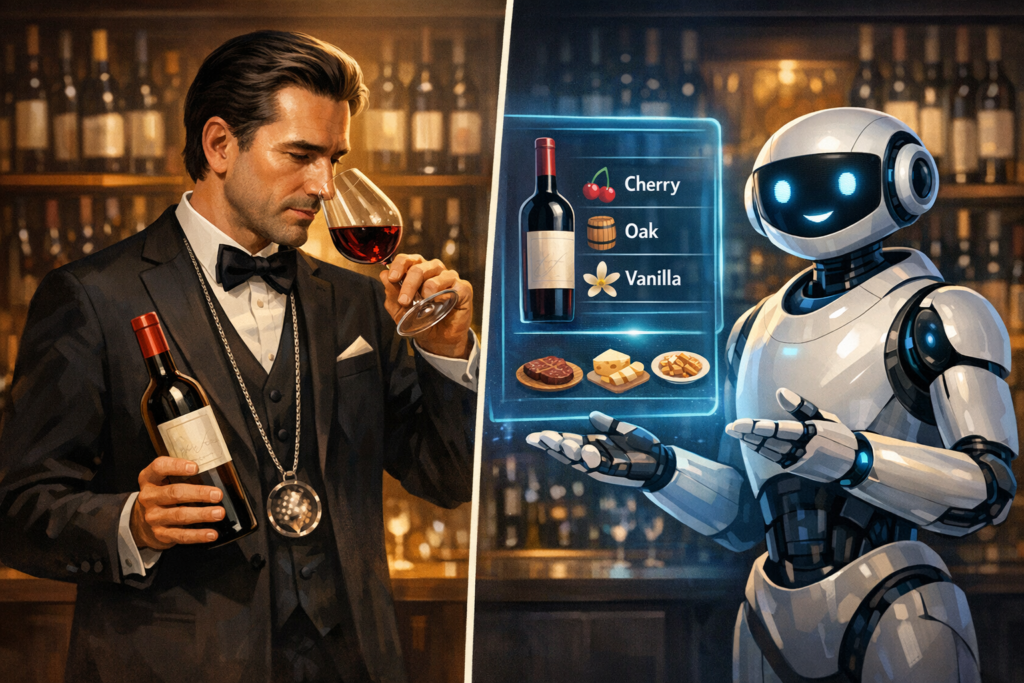
Wine has long been a domain where expertise, ritual and personal taste collide. For centuries, sommeliers have guided diners through cellars, balanced budgets with flavor, and translated terroir into stories. Now, artificial intelligence is stepping up to the table. As large language models and multimodal systems move beyond text into images and structured data, they promise fast, personalized wine advice at scale. That raises a provocative question: when it comes to recommending a bottle, matching food and flagging cellar-worthy buys, who does a better job — a seasoned sommelier or an AI assistant?
Not a duel of equals, but a shift in roles
Framing this as a head-to-head contest misses the point. AI and human sommeliers are not built from the same materials: one is an algorithm trained on patterns in data, the other is a human synthesizer of sensory memory, hospitality judgment and contextual sensitivity. The real competition is in value delivered to consumers and businesses. AI excels at scale, speed, and personalization from sparse signals; sommeliers excel at sensory nuance, service design and trust. The intersection — hybrid workflows — will most likely determine winners in restaurants, retail and direct-to-consumer wine services.
Where AI has clear advantages
Several technical strengths make AI compelling for wine advice:
- Mass personalization: LLMs and recommender systems can combine purchase history, flavor preferences, price sensitivity, and even health constraints to produce customized suggestions for thousands of users simultaneously. This is beyond the reach of a single sommelier.
- Scale of knowledge: AI can consolidate tasting notes, critic scores, vintage histories, vineyard data, and online reviews into an accessible answer within seconds. That breadth helps uncover underrated bottles or compare cellar investment value quickly.
- Multimodal recognition: Vision-capable models can read wine labels, assess bottle condition from photos, and map labels to databases — useful for resellers or collectors verifying provenance at scale.
- Operational integration: AI can be tied into inventory systems, menus and dynamic pricing to recommend bottles that are actually available and profitable, reducing waste and improving margins.
- Accessibility and onboarding: For casual drinkers or novice staff, AI provides instant guidance where sommeliers aren’t present, democratizing wine discovery.
Productization examples that make sense
Imagine a restaurant app that, based on your past orders and current table size, suggests a flight of three bottles that complement your menu choices and fit a target spend. Or a retail site that scans a cellar photo, identifies bottles, flags counterfeit risks, and recommends optimal drinking windows or resale value. These are realistic near-term deployments where AI augments human expertise and unlocks new revenue streams.
The human edge: nuance, hospitality and credibility
AI’s limits become especially evident in areas where wine advice is less about information and more about human connection and sensory discrimination:
- Sensory subtlety: Somms rely on years of tasting to parse texture, balance and the fleeting sense impressions that are hard to codify. Describing tannin structure, mid-palate lift or the exact nuance of botrytis requires calibrated human judgment.
- Service design: A sommelier reads the room — mood, occasion, diners’ aversions — and shapes recommendations with storytelling and theatricality. That contributes to perceived value and willingness to spend.
- Trust and accountability: When diners ask for a sommelier’s recommendation at an upscale dinner, they expect a liability-free guarantee of compatibility and service. Accountability is murky with AI-generated advice, especially if it leads to poor experiences or allergic reactions.
- Ethical curation: Sommeliers can resist incentives tied to commercial deals; AI systems, if improperly structured, may prioritize affiliate-linked bottles or sponsored listings without transparent disclosure.
Key technical and business risks
Implementing AI wine advisers isn’t just a matter of training a model. There are several practical hazards companies must manage:
- Hallucination and misinformation: LLMs can invent details — fake tasting notes, nonexistent vintages, or inaccurate drinking windows — unless grounded to verified datasets.
- Data bias and cultural blind spots: Training data skewed toward well-covered wine regions and critics can leave lesser-known producers underrepresented, reinforcing existing market inequality.
- Legal and regulatory risk: Recommending alcohol raises compliance questions around age verification, advertising restrictions, and liability for health-related advice (e.g., pairing where allergens are present).
- Commercial conflicts: Without careful design, AI systems may be monetized through affiliate deals that bias recommendations, eroding consumer trust.
- Sensory limitations: AI lacks a palate; while it can simulate tasting descriptors, its “understanding” is inferential, not experiential, which becomes problematic for high-end, sensory-driven selections.
How businesses will compete and collaborate
Restaurants, retailers and startups will choose among several strategic approaches:
- AI augmentation for staff: Tools that assist sommeliers by surfacing data, alternative pairings, or pricing strategies — enhancing, not replacing, human judgment.
- Consumer-grade AI advisors: Chat-driven assistants for mass-market usage that optimize for affordability and convenience rather than haute-cuisine nuance.
- Hybrid concierge services: Subscription models combining algorithmic discovery with human sommelier consultation for premium customers.
- Verification platforms for collectors: Services that pair visual verification, blockchain-backed provenance and AI valuation to serve secondary markets and insurers.
These strategies will map to different customer segments. Casual buyers prioritize convenience and price. Connoisseurs pay for expertise, narrative and experience. Wine merchants and restaurants will have to decide which audience they serve and how much to rely on automated advice versus curated service.
Regulatory and industry implications
As AI influences buying behavior and pricing, regulators and industry bodies will pay attention. Potential developments to watch:
- Standards for model transparency — requirements to disclose data sources or commercial relationships when making recommendations.
- Guidelines for age verification and responsible alcohol promotion integrated into AI endpoints.
- Industry-led certification for AI wine advisors, analogous to sommelier credentials, to build consumer trust.
- Quality control frameworks ensuring AI recommendations are grounded in validated wine databases and critic consensus rather than scraped opinions.
Three plausible trajectories
Projecting forward, there are at least three realistic scenarios for AI’s role in wine advisory:
- Complementary augmentation (most likely): Restaurants and retailers adopt AI tools that enhance sommelier workflows and improve consumer discovery. Customers enjoy better matching and lower search friction while sommeliers focus on value-added experiences.
- Platform commodification: Large e-commerce and delivery platforms use AI to recommend private-label or sponsored wines, prioritizing margin. This drives volume but flattens diversity and diminishes the role of independent sommeliers.
- Specialized substitution: For mid-market and casual contexts, AI substitutes for human advice entirely, becoming the default for pairings and cellar management. High-end dining and collectors remain human-centered.
What would success look like?
For AI wine advisors to be seen as credible, they must satisfy three conditions:
- Accuracy and grounding: Recommendations anchored in validated data (vintage charts, critic scores, producer info) and real-world availability.
- Transparency and incentives: Clear disclosure of commercial relationships, with UX that lets users understand why a bottle was suggested.
- Human-in-the-loop options: Easy escalation to a human sommelier or an explicit blended workflow for when nuance and service matter most.
The new value proposition for sommeliers
Sommeliers who embrace AI tools stand to expand their influence. They can curate AI-generated lists, validate algorithmic picks with tasting expertise, and offer higher-touch services to justify premium pricing. Moreover, credentialed sommeliers will be well-positioned to audit AI models, contribute tasting notes to improve datasets, and develop branded experiences that mix technology and hospitality.
Final pours: taste, trust and technology
AI will not drink your wine for you. It will, however, help you discover new bottles, avoid poor buys and scale wine knowledge to people who have never stepped into a tasting room. The decisive battleground won’t be a pure AI vs sommelier fight but the hybrids that preserve sensory and ethical rigor while delivering the convenience and personalization AI enables. In that balance lies the future of wine advice: not a replacement of human artistry, but an amplification of it — if the industry resists short-term commercial shortcuts and invests in accuracy, transparency and human-centered design.
For consumers, the best strategy is simple: use AI where it speeds discovery and cuts friction, but rely on people when occasion, nuance and trust matter. For businesses, the challenge is to design product experiences that align incentives, respect the craft and add measurable value to both the cellar and the table.