
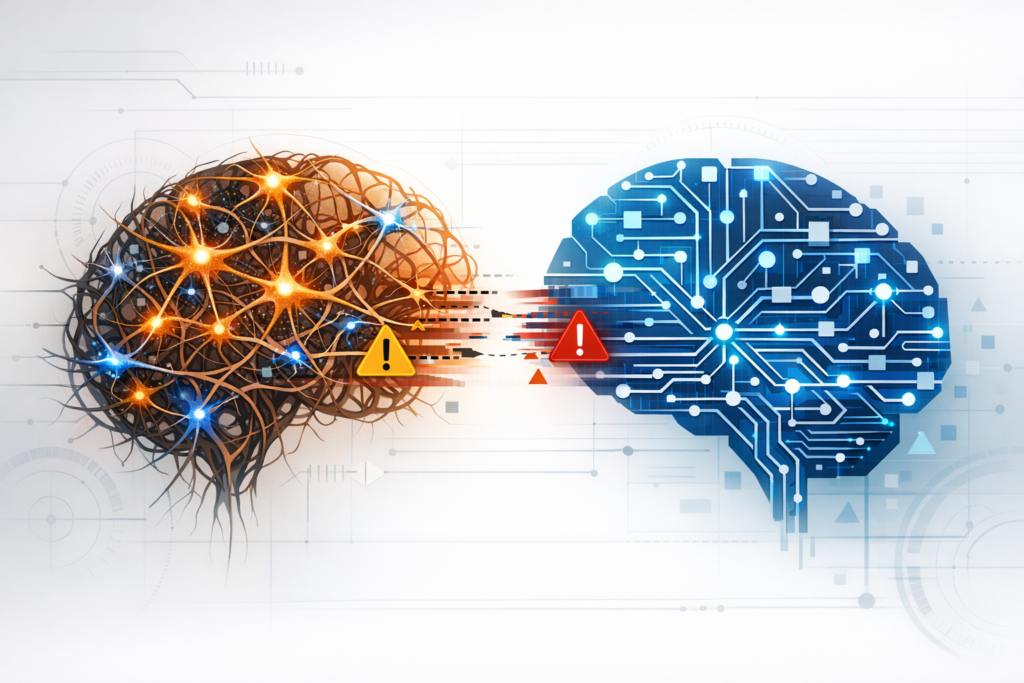
Why a “brain-like” label can be misleading — and why that matters for the future of AI
The idea that modern AI systems are beginning to look and think like brains has become a powerful narrative across research labs and boardrooms. It fuels investments in brain-inspired architectures, justifies neuromorphic chips, and frames partnerships between neuroscience and industry. But recent work has pulled at a thread in that narrative, revealing systematic mismatches between the internal workings of artificial neural networks and biological neural systems. Those mismatches aren’t merely academic quibbles. They change how we should judge progress, allocate funding, and design the next generation of models and hardware.
This piece explores what those hidden mismatches mean for AI strategy, research priorities, and the emerging business landscape connecting neural data, algorithms, and devices.
Beyond correlational resemblance: the problem with superficial similarity
It’s easy to conflate two types of similarity. First is outward behavior: a model and a brain may both recognize objects or predict sensory inputs. Second is internal mechanism: whether the patterns of activity, representational geometry, and causal role of units correspond between the two systems. Many evaluations focus on the first. If a deep network’s activations correlate with neural recordings in some brain area, headlines proclaim “AI mirrors the brain.” But correlation is not explanation.
Recent research shows that correlation-based measures can be driven by confounds—shared statistics in inputs, preprocessing choices, or even simple feature detectors—rather than a match in computation. In other words, two systems can arrive at similar outputs for very different internal reasons. When investigators probe more deeply—examining how representations change under perturbation, how temporal dynamics unfold, or whether single units play similar causal roles—a different picture often emerges: AI and brain can be functionally aligned at the level of task but misaligned in how they encode and manipulate information.
Where the mismatches typically appear
– Representational geometry: Even if activation vectors are correlated, the structure of those vectors—how clusters and axes are arranged—can diverge. That affects generalization and robustness.
– Temporal dynamics: Brains operate with specific time-based computations, recurrent loops, and oscillatory structure that many feedforward deep networks lack.
– Single-unit roles: Neurons in the brain often serve multiplexed roles, participating in different computations depending on context. Artificial units frequently behave more rigidly.
– Causality vs. correlation: A unit that correlates with a sensory feature isn’t necessarily causally involved in producing behavior. Causal interventions reveal these differences.
– Learning mechanisms: Biological synaptic plasticity and neuromodulatory systems differ substantially from gradient descent; similar behavior can arise from different learning rules with different implications for adaptation speed and sample efficiency.
Each mismatch carries downstream consequences. Where representations differ, transfer learning may fail in unexpected ways. Where temporal dynamics diverge, systems may show brittle behavior in active perception or closed-loop control.
Strategic implications for AI research and industry
If the industry treats superficial similarity as synonymous with mechanistic equivalence, stakeholders risk misdirecting resources. Several strategic implications follow.
– Rethinking benchmarks: Metrics that reward only output-level performance or input-response correlations need augmentation. Benchmarks should include perturbative tests, temporal alignment, and causal interventions that probe mechanism, not just behavior.
– Product claims and marketing: Companies touting “brain-like” capabilities for neuromorphic chips, BCIs, or model architectures should calibrate claims to avoid regulatory pushback or customer disillusionment. Accuracy in these narratives will influence investor trust and public acceptance.
– Hardware bets: The push toward neuromorphic hardware assumes that emulating certain brain features yields efficiency or performance benefits. If the computational primitives differ meaningfully, some neuromorphic designs may underdeliver outside narrow niches. That said, there’s still valuable cross-pollination—biological constraints can inspire energy-efficient architectures even if they aren’t literal replications.
– Research funding: Funders must balance investments between high-level biologically inspired ideas and rigorous, mechanism-focused validation. Overemphasizing narrative at the cost of causal testing delays robust progress.
Opportunities: better science, better tech
Exposing mismatches is not a setback but an opportunity. It forces methodological upgrades that elevate both neuroscience and AI.
– Causal benchmarking frameworks: Adopting interventionist experiments—ablations, counterfactual stimuli, closed-loop perturbations—can reveal whether similar-looking representations actually perform the same computations. This will improve interpretability and model debugging.
– Hybrid architectures: Recognizing what aspects of brain computation are useful (e.g., sparse connectivity, event-driven processing, hierarchical recurrence) allows designers to selectively import principles into efficient hybrid models rather than chasing wholesale emulation.
– Improved sample efficiency and robustness: Understanding why brains generalize with limited data can yield new learning rules and architectures. But discovering those rules requires careful mapping beyond correlation.
– Cross-disciplinary toolkits: New analytics—temporal representational similarity, causal role analysis, and geometry-aware alignment—become shared tools that benefit both fields. Companies that adopt these tools will have an edge in developing robust, explainable AI and neurotechnology.
Regulatory and ethical contours
Nuanced claims about “brain-likeness” matter for governance. Regulators may scrutinize devices and models touted as “neural” or “cognitive” if those claims influence medical decisions, consumer behavior, or privacy. Several regulatory considerations emerge:
– Truthful marketing: Misrepresenting model capabilities undermines consumer protection and could invite stricter regulatory regimes around neurotech claims.
– Data governance: High-quality neural datasets—necessary for mechanistic comparisons—are sensitive. Privacy-preserving sharing agreements and standards will be critical.
– Safety testing: If industry pursues brain-inspired control systems in safety-critical domains, regulators will demand causal, not just correlational, validation demonstrating that models behave sensibly under perturbation.
Competitive dynamics and business outcomes
Big tech, startups, and academic consortia are already vying to define what “brain-inspired” means. The mismatch critique reshuffles competitive advantages.
– Incumbents with compute and data will keep pushing large models, but their claims of biological fidelity will be questioned. They can defend investments by adopting richer validation methods and transparency about differences.
– Startups focused on neuromorphic hardware may need to demonstrate niche advantages (power, latency) through controlled benchmarks rather than grand claims of brain equivalence.
– Academic labs and consortia stand to gain influence by producing rigorous, open-source benchmarks for mechanistic alignment. Those standards will shape procurement decisions for government and industry funding.
– Neurotech firms building BCIs must prioritize causal validation to show that decoder models genuinely map to relevant neural computations, improving clinical efficacy and attracting reimbursements.
Three plausible futures
1) Convergent rigor: The field responds to the mismatch critique by standardizing causal benchmarks and richer validation frameworks. Progress slows in headline terms but accelerates in robustness and transferability. Funding shifts toward reproducibility, and neurotech products gain credibility.
2) Hype persists: Superficial metrics dominate marketing. Neuromorphic and BCI investments continue under inflated promises. Some commercial failures and regulatory interventions follow, eroding public trust and constricting funding pipelines.
3) Breakthrough alignment: Focused scientific work identifies the critical brain mechanisms that actually confer sample efficiency and robustness. Researchers translate those mechanisms into novel architectures and learning rules that outperform current methods in specific domains, spawning a second wave of transformative AI and credible neurotech.
None of these are mutually exclusive across fields or regions. Different players may pursue different routes in parallel, and outcomes will hinge on how the community responds to methodological critiques.
Practical recommendations for leaders
– For research directors: Institute evaluation pipelines that combine behavioral metrics with causal and temporal probes. Prioritize reproducible benchmarks and cross-disciplinary review.
– For investors: Insist on mechanistic validation in due diligence. Favor ventures that provide robust evidence beyond activation correlations.
– For product teams: Be precise about claims. If a model or chip is “inspired by” biological systems, detail which elements were adopted and why.
– For policymakers: Support standards for neurodata sharing and certify testing protocols for safety-critical neurotech applications.
Closing thought
The revelation of hidden mismatches between artificial and biological neural systems reframes a key question: should AI aim to mimic brains exactly, or should it learn from them selectively? The smarter path is neither blind emulation nor wholesale rejection, but disciplined translation—identifying which biological mechanisms offer practical computational payoffs and validating them with tools that test causality, dynamics, and geometry. Doing so will turn the brain not into a marketing slogan but into a rigorous source of inspiration for the next era of trustworthy, efficient, and explainable AI.