
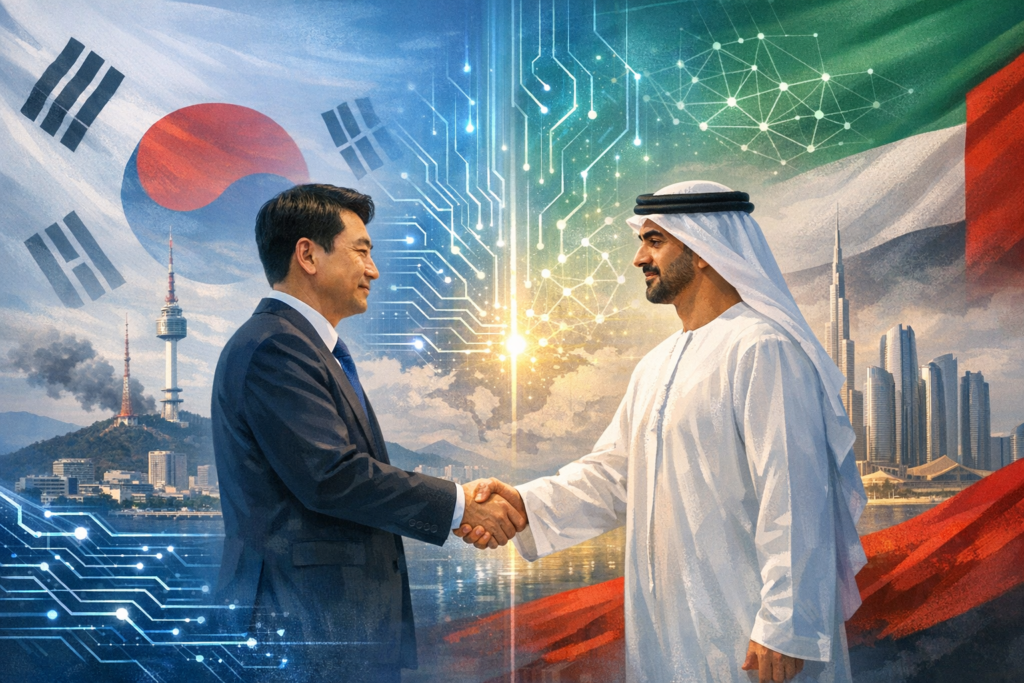
Why this matters: When two technologically ambitious states like South Korea and the United Arab Emirates pivot toward deeper AI collaboration in the aftermath of a regional conflict, the shift is not merely bilateral—it reshapes supply chains, investment flows, regulatory norms, and strategic technology trajectories across industries. Expect accelerated commercialization of dual‑use AI, new routes for talent and capital, and fresh regulatory conversations about AI governance and security.
What happened — a concise explanation
In the wake of recent regional instability that amplified concerns about security and economic resilience, South Korea and the UAE signaled an intention to fast‑track AI cooperation. This involves expanding research partnerships, joint investments, and coordinated projects across defense, energy, smart cities, healthcare, and finance. The partnership leverages South Korea’s hardware, semiconductor, robotics and software engineering strengths with the UAE’s capital, infrastructure projects, cloud capacity and regional access.
Why this matters for the AI industry
This is a strategic pairing: South Korea brings advanced semiconductor manufacturing, system integration, and a thriving AI startup ecosystem; the UAE brings sovereign wealth, regulatory agility, and national-level AI initiatives. The result is faster commercialization of AI systems across sectors and an emergent model for how middle powers can shape AI capabilities without relying exclusively on U.S. or Chinese ecosystems.
Key dimensions of impact
- Supply‑chain resilience: Closer ties could diversify chip and server supply channels, reducing single‑market dependencies and accelerating onshore data center deployment in the Gulf.
- Capital + commercialization: UAE sovereign funds and private investors can rapidly scale South Korean AI startups and industrial projects, turning R&D into large‑scale deployments.
- Dual‑use acceleration: Projects combining civilian and defense applications—surveillance analytics, autonomous logistics, and secure communications—will move faster under joint ventures and government support.
- Regulatory and standards influence: Coordinated policy approaches between the two states could influence regional norms for AI ethics, export controls, and data governance.
Who stands to benefit
- South Korean technology companies (chipmakers, system integrators, robotics, cloud and telecom firms): access to Gulf capital, large‑scale projects, and shorter customer feedback loops for industrial AI.
- UAE investors and public sector agencies: rapid capability build‑out in sovereign AI, smart infrastructure and defense technologies without developing all technology in‑house.
- AI startup ecosystems: startups in both countries could benefit from cross‑border scaling opportunities—market entry support from Abu Dhabi’s funds and R&D partnerships with Korean universities and labs.
- Sector adopters: oil & gas companies, utilities, healthcare providers and smart city operators will get faster access to advanced AI tools for predictive maintenance, resource optimization and citizen services.
Who is threatened or challenged
- Incumbent providers in Western or Chinese ecosystems may face competition for contracts in the Middle East and Asia as a new Korea‑UAE axis offers alternatives.
- Human rights and oversight advocates worry that rapid adoption of surveillance and defense AI without strong governance could erode civil liberties and export risky dual‑use systems.
- Regional competitors might see shifts in influence: states that previously relied on narrow supplier relationships could find geopolitics reshaped by new technology ties.
Market implications — investment, supply chain, and talent
The partnership will ripple through markets in predictable and less‑predictable ways:
- Chip demand and manufacturing: Increased AI projects raise demand for GPUs/AI accelerators and for localized server infrastructure. South Korea could see new fabs and packaging investments tied to Gulf financing, while the UAE could become a regional edge‑compute hub.
- Cloud and data center markets: Joint investments will boost data center capacity in the GCC, encouraging global cloud players to partner or compete. Data localization and low‑latency service needs will drive regional cloud offerings optimized for Arabic language models and regional compliance.
- M&A and VC flows: Expect strategic acquisitions and late‑stage funding rounds for Korean AI firms, and cross‑border incubators funded by UAE sovereign entities to accelerate exits and deployments.
- Talent migration and training: Joint scholarships, lab exchanges, and talent mobility programs will be prioritized, creating bi‑directional pipelines of engineers, AI researchers, and operational specialists.
Business impact — practical use cases
Below are concrete applications where Korea‑UAE cooperation could rapidly produce business outcomes:
- Autonomous logistics and port operations: AI‑driven scheduling, robotic handling and predictive maintenance in logistics hubs like Jebel Ali could be co‑developed with Korean robotics and control systems.
- Energy and predictive maintenance: Oil, gas and renewable operators can deploy machine‑vision and time‑series models for turbine, pipeline and grid optimization—reducing downtime and emissions.
- Urban AI for smart cities: Integrated traffic management, energy optimization, waste collection routing and public safety analytics, built on Korean sensors and UAE city pilots.
- Arabic and multilingual LLMs: Collaborative dataset efforts could produce large language models better tuned to Arabic dialects, boosting conversational AI for banking, government services, and healthcare.
- Healthcare diagnostics and telemedicine: AI image analysis and remote diagnostics deployed across the UAE’s health networks with Korean clinical AI technology and hospital integrations.
Risks and governance considerations
Rapid cooperation brings risks that must be managed to sustain long‑term value:
- Export control and compliance: Dual‑use AI and advanced semiconductors may trigger export restrictions. Partners must design compliant supply chains and licensing models.
- Data governance: Cross‑border datasets used to train models raise privacy, sovereignty and bias concerns. Clear data‑sharing agreements and privacy‑preserving techniques (federated learning, synthetic data) are essential.
- Ethical deployment: Surveillance and autonomous systems require frameworks for oversight, transparency, and human‑in‑the‑loop controls to prevent misuse.
Short‑ and medium‑term predictions (12–36 months)
- Multiple memoranda of understanding and joint research centers announced, focused on semiconductors, edge AI and cloud infrastructure.
- UAE sovereign funds make strategic investments into South Korean AI scaleups and semiconductor suppliers; Seoul supports targeted incentives to secure critical exports.
- Deployment pilots in energy, ports and urban management move to production, demonstrating ROI and prompting faster procurement across the region.
- Regulatory collaborations begin—alignment on AI safety standards, export screening processes, and pilot frameworks for autonomous systems.
Strategic recommendations for stakeholders
- For AI vendors: Localize solutions for Arabic language and regional regulatory needs; pursue joint ventures with UAE entities to access capital and scaling opportunities.
- For investors: Prioritize companies with dual‑track capabilities—commercial and defense/compliance readiness—and those with strong IP in semiconductors, data handling, and edge computing.
- For policymakers: Create transparent export and data governance regimes that protect national security without stifling innovation; invest in workforce programs to retain talent domestically.
FAQ
Q: Will this cooperation change the global AI landscape?
A: It won’t single‑handedly redraw the landscape, but it will create a meaningful alternative corridor for technology development and deployment that can reduce concentration risk and introduce new regional standards.
Q: Are these projects primarily civilian or military?
A: Expect a mix. Many AI capabilities—sensing, autonomy, analytics—are dual‑use. Transparency and governance will determine whether civilian benefits are realized without exacerbating security concerns.
Q: How will this affect chip and server supply chains?
A: It will increase regional demand for accelerators and drive investments in localized fabs and data centers, prompting incumbents to either partner or face competitive pressure in the Middle East and parts of Asia.
Q: What does this mean for AI ethics and privacy?
A: The faster pace of deployment increases the urgency of robust ethics frameworks. Collaborative governance models, privacy‑preserving tech and external audits will be necessary to mitigate risks.
Q: Should startups engage with this partnership?
A: Yes—especially those with domain expertise in energy, healthcare, logistics or Arabic language AI. Strategic partnerships can accelerate scaling, but startups must ensure compliance, IP protection, and ethical safeguards.
Conclusion
South Korea and the UAE accelerating AI cooperation after a period of regional instability is not just a bilateral development; it signals a practical new model for technology diplomacy. By combining Korea’s engineering and semiconductor strengths with the UAE’s capital, infrastructure and strategic ambition, the partnership can deliver rapid, industry‑scale AI deployments across energy, logistics, healthcare and urban systems. The upside is substantial—improved resilience, faster commercialization and a diversified global AI ecosystem—but so are the governance and security challenges. Success will depend on transparent frameworks for data, exports and ethics, and on smart public‑private collaborations that turn advanced capabilities into measurable public and commercial value.