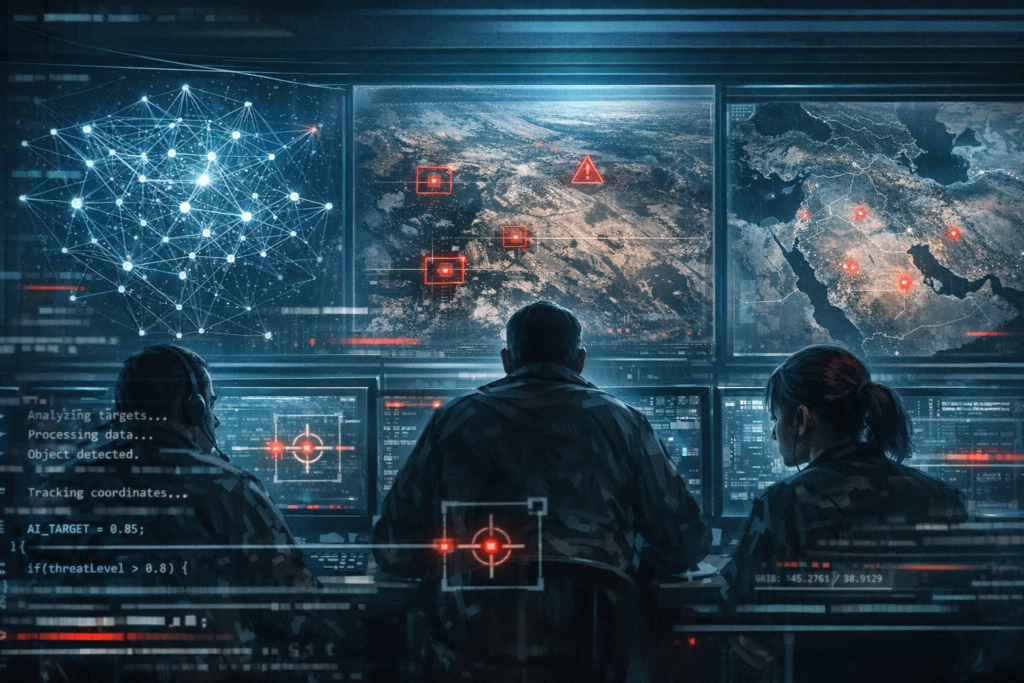
The U.S. military’s public confirmation that it deployed advanced AI tools in operations against Iranian targets marks more than a tactical footnote — it signals a turning point in how warfare will be fought, procured, regulated and perceived. This development accelerates the integration of machine learning, sensor fusion and autonomous decision-support into frontline operations, and raises urgent questions about accountability, escalation risk and the economics of defense technology.
What happened — the short, clear version
The Department of Defense acknowledged that sophisticated artificial intelligence systems were used to support recent operations directed at Iranian-linked forces. While specifics about which models or platforms were employed remain limited in public statements, the admission indicates AI was used for functions such as sensor data fusion, targeting support, threat correlation and potentially autonomous ISR (intelligence, surveillance and reconnaissance) tasks. The confirmation breaks a long-standing pattern of silence around the operational use of AI in kinetic contexts and makes explicit what many analysts have considered inevitable.
Why this matters: four immediate implications
- Normalization of AI-enabled targeting: Once AI is acknowledged as a functional element in kinetic operations, its acceptance across allied and adversarial militaries accelerates.
- Procurement and industry disruption: Demand for AI-capable platforms will increase, shifting procurement toward software-centric, rapid-update models rather than hardware-dominant programs of record.
- Regulatory and ethical pressure: Public disclosure of AI use draws scrutiny from lawmakers, human rights groups and international bodies asking for transparency, audits and guardrails.
- Escalation and attribution dynamics: Decision latency drops, and adversaries may face compressed windows for response — increasing the risk of inadvertent escalation if AI systems make or recommend actions that are misinterpreted.
How AI was likely used (and what that means operationally)
Public confirmations rarely enumerate technical details, but the profile of modern military AI use follows common patterns. Key roles likely included:
- Sensor fusion and target identification: Combining radar, SIGINT, EO/IR and open-source data to create a consolidated battlespace picture and identify high-value individuals or assets faster than human analysts alone.
- Predictive analytics and pattern-of-life modeling: Using ML models to anticipate movements, logistics flows, or attack windows to time actions with higher probability of success.
- Autonomous ISR and reconnaissance: Enabling drones or unmanned systems to loiter, search and relay possible targets with reduced operator workload.
- Decision-support and mission planning: Recommending courses of action, simulating outcomes and highlighting legal or collateral-risk factors for commanders.
Why these uses are strategically significant
Each of the functions above shortens the observe-orient-decide-act (OODA) loop. That advantage can be decisive in fast-moving engagements — but it also concentrates power in software, where bugs, bias or adversarial inputs can produce outsized consequences. The combination of speed and opacity is what makes this moment both potent and perilous.
Who benefits — winners from this shift
- Defense primes and software firms: Companies that can deliver scalable AI architectures, secure data pipelines and model lifecycle management stand to win large, multi-year contracts.
- AI infrastructure providers: Cloud, edge compute and specialized accelerators (GPUs/TPUs) will see increased demand as militaries operationalize high-throughput ML workloads.
- Startups with dual-use capabilities: Firms that can pivot commercial ML stacks for defense use (e.g., computer vision, sensor fusion, autonomy) will be attractive acquisition targets.
- Allied nations with interoperable systems: Partners able to integrate similar AI tools benefit from shared data, joint training and synchronized doctrine.
Who is threatened — risks and losers
- Civilians and non-combatants: Risk of misidentification increases if models are biased or trained on incomplete data, raising humanitarian and legal concerns.
- Smaller states and non-state actors: Entities without AI capabilities may find their strategic options constrained against AI-enabled adversaries.
- Privacy, civil liberties and transparency advocates: Rapid military use of sophisticated surveillance and predictive tools triggers long-term societal debates about acceptable norms.
- Companies dependent on legacy procurement cycles: Vendors that cannot produce modular, rapidly updateable AI systems risk losing contracts to more agile competitors.
Market and business implications
The defense market is pivoting toward software-first value propositions. Expect financial and strategic shifts across the ecosystem:
- Surge in defense AI investments: Venture and corporate capital will flow into AI startups addressing autonomy, secure MLops, explainability and adversarial robustness.
- Mergers and acquisitions: Established defense primes will accelerate tuck-in acquisitions to gain talent, IP and cloud-native capabilities.
- New revenue models: Subscription-based AI services for continuous model updates, threat intelligence feeds and validated datasets will emerge within procurement frameworks.
- Stock and valuations: Public firms providing AI-enabled ISR, autonomy and secure communications may see re-rating; contractors slow to adapt could face multiple headwinds.
Real-world use cases (concrete examples)
- Autonomous convoy protection: ML models detect roadside threats and reroute unmanned escorts to reduce risk to personnel.
- Maritime domain awareness: Sensor fusion systems track small craft and launch interdiction advisories before adversaries close in on assets.
- Counter-drone operations: AI identifies hostile UAS signatures, prioritizes intercepts and allocates kinetic or electronic-jamming assets.
- Rapid targeting cycles: Analysts use AI to aggregate multi-source intelligence, flag legitimate targets and generate legal and collateral risk assessments for commanders in near real-time.
Future predictions — what to expect in the next 3–5 years
- Wider proliferation: Peer and near-peer adversaries will accelerate their own AI programs, compressing qualitative advantages.
- Norms and governance emerge: International frameworks — from export controls to operational ethics standards — will be negotiated, though enforcement will lag adoption.
- Human-on-loop becomes doctrine: Militaries will formalize commanders’ roles as final decision-makers, but pressure to reduce human latency will grow.
- Adversarial tactics rise: Opponents will employ data poisoning, spoofing and electronic attack to degrade AI performance, sparking an arms race in model robustness.
- Commercial spillover: Civil sectors (logistics, emergency response, critical infrastructure) will adopt hardened AI techniques developed for defense, accelerating dual-use diffusion.
Expert recommendations — how industry and policymakers should respond
- Invest in explainability and auditability: Mandatory logging, provenance tracking and causal explanations for model outputs should be part of procurement criteria.
- Establish red-team practices: Regular adversarial testing and independent verification of models to identify failure modes before deployment.
- Define clear human-AI roles: Operational doctrine must codify when human overrides are required, and how liability is assigned when systems err.
- Promote interoperable standards: Allies should harmonize data formats and security baselines to facilitate trusted sharing and joint operations.
- Control sensitive exports thoughtfully: Balancing deterrence and innovation, export controls should focus on capabilities that materially change escalation dynamics.
Short FAQ
Q: Does AI decide to pull a trigger?
A: In most democracies and official doctrines today, humans retain final authority for lethal action. However, AI increasingly provides recommendations and can autonomously perform support tasks (surveillance, cueing, targeting aids). The line between support and autonomy is operationally thin and contentious.
Q: Will this make conflict more likely?
A: AI shortens decision timelines, which can both deter and destabilize. Faster, more precise options might discourage some attacks, but misclassification or opaque model behavior could provoke unanticipated escalation.
Q: How will this affect private-sector AI firms?
A: Firms with secure, explainable, and deployable AI stacks stand to gain defense contracts. Others may face reputational risks if their technologies are used in controversial operations, and must weigh ethics, compliance and market opportunities carefully.
Q: Are there legal or ethical frameworks in place?
A: Some frameworks exist (international humanitarian law, DoD directives, export controls), but many argue current rules lag technological capabilities. Expect intensified policymaking, litigation and public debate as deployments increase.
Conclusion
The U.S. military’s confirmation that advanced AI tools were operationally employed against Iranian targets is a watershed moment: it propels AI from experimental demonstrations into active combat support. This transition brings strategic advantages and market opportunities, but also a profusion of risks — ethical, operational and geopolitical. For industry leaders, policymakers and citizens, the challenge is clear: harness AI’s potency while erecting rigorous oversight, technical safeguards and multilateral norms to prevent inadvertent harm and uncontrolled escalation. How governments and companies respond now will shape whether AI becomes a force-multiplier for stability or a catalyst for new insecurities.