
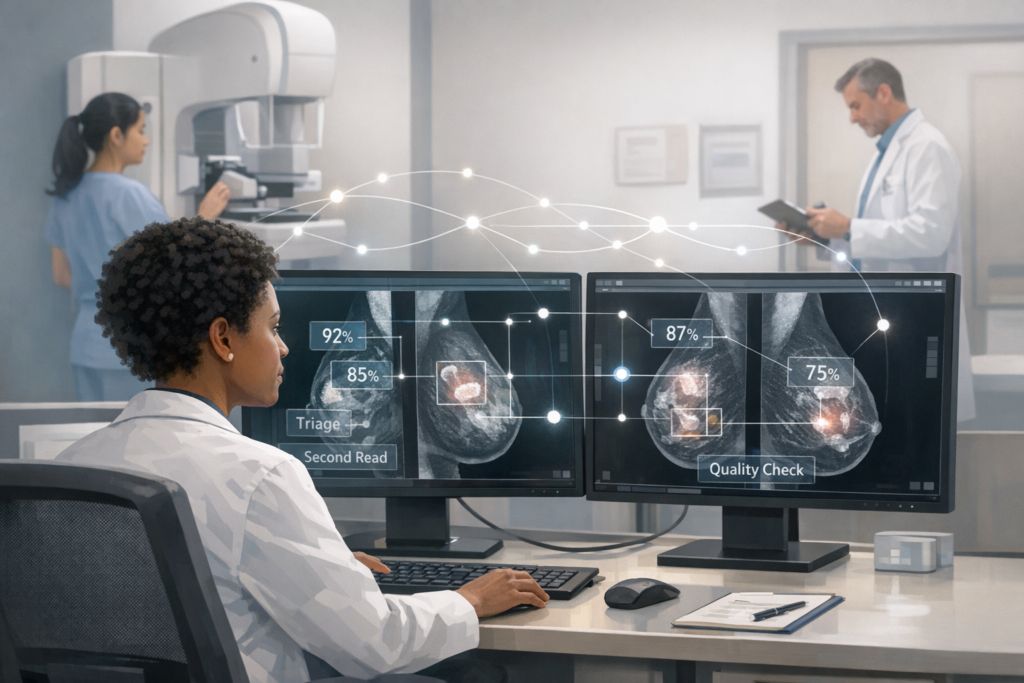
Why this matters: A prospective clinical study from a major imaging vendor shows artificial intelligence can meaningfully improve breast cancer screening performance across multiple clinical workflows. That finding accelerates the shift from experimental AI pilots to practical, deployable tools that change how screening programs operate, how radiologists work, and how healthcare systems measure value from imaging.
What happened: a prospective study that changes the conversation
GE Healthcare recently reported the results of a prospective study evaluating an AI solution for breast cancer screening. Unlike retrospective analyses that replay old cases, this study immersed the algorithm into live screening workflows to assess real-world impact. The AI tool was tested across different clinical reading models — from single-reader to double-read workflows and as an assistive second reader — and produced measurable improvements in cancer detection metrics while maintaining acceptable recall and false-positive rates.
Key takeaways from the study
- Improved detection: The AI system increased overall cancer detection rates across tested workflows.
- Workflow-agnostic benefit: Gains were seen regardless of whether the AI acted as a triage tool, a concurrent reader, or a second opinion.
- Operational advantage: The technology supported more consistent prioritization of cases and helped focus radiologist attention on higher-risk studies.
- Preserved specificity: Importantly, improved sensitivity did not come with a large penalty in false positives or unnecessary recalls.
Deeper analysis: why this matters for the AI industry
This prospective demonstration is consequential for three reasons:
1. Prospective evidence accelerates adoption
Regulators, payors, and hospital procurement teams place high value on prospective data because it better reflects operational realities — variability in image quality, heterogeneous patient populations, and human-AI interaction. Positive prospective results reduce adoption friction by shifting discussions from theoretical benefit to demonstrated clinical value.
2. AI becomes workflow technology, not just an algorithm
Historically, imaging AI vendors pitched accuracy metrics on static datasets. This study emphasizes that the utility of AI depends on how it fits into daily workflows. Vendors that design flexible, workflow-aware integrations (triage, concurrent reading, or second reads) will outcompete those offering one-size-fits-all tools.
3. Raises the bar for validation standards
Prospective trials will soon be expected for high-impact AI tools. As more vendors follow suit, healthcare systems will favor products validated in the real world, making clinical trial design and post-market surveillance core competitive differentiators.
Who benefits—and who faces disruption
Winners
- Patients: Earlier and more accurate detection translates to better prognosis and reduced downstream costs.
- Radiology departments: Improved prioritization reduces diagnostic delays and optimizes allocation of scarce radiologist time.
- Healthcare systems & payors: Higher detection with controlled recall rates reduces long-term treatment costs associated with late-stage cancers.
- AI vendors with strong clinical evidence: Prospective validation becomes a market moat that supports premium pricing and faster enterprise adoption.
Those under pressure
- Vendors without clinical evidence: Companies relying on retrospective claims may find procurement doors closing.
- Radiologists resistant to change: Clinicians who refuse to adapt workflows risk lower productivity or exclusion from screening programs that mandate AI-assisted reads.
- Legacy imaging software providers: Platforms that cannot integrate third-party AI or lack hooks for real-time decision support will see their value proposition erode.
Market implications and business impact
This study nudges the market toward normalization of AI-assisted screening. Expect several downstream effects:
- Commercial acceleration: Hospitals and imaging networks will accelerate procurement of breast imaging AI as part of EMR/PACS refresh cycles.
- Pricing power for validated vendors: Demonstrated clinical utility supports higher license fees or outcome-based contracts tied to detection metrics.
- Consolidation pressure: Larger imaging vendors and enterprise AI platforms will seek to acquire clinically validated niche players to bundle validated tools with imaging hardware and PACS software.
- Reimbursement conversations: Positive prospective data strengthens the case for procedure-level or facility-level reimbursement for AI-assisted screening, raising the likelihood of new CPT or DRG modifiers over the next 2–4 years.
- Regulatory and liability shifts: As AI changes the standard of care, institutions and payors will re-evaluate malpractice risk and coverage models for AI-augmented reads.
Real-world use cases: how hospitals will put this into practice
Triage and prioritization
AI flags high-probability positive screens for expedited review, shortening time-to-diagnosis. This is especially valuable in high-volume programs or resource-constrained settings where radiologist backlog is a bottleneck.
Concurrent assistance for single-reader settings
Many U.S. centers operate single-reader workflows. In these environments, AI provides a safety net — highlighting suspicious regions and reducing the chance of missed cancers without requiring a formal second read.
Second-reader support in double-read programs
In jurisdictions with double-reading norms (e.g., parts of Europe), AI can serve as an independent third opinion, increasing sensitivity while providing reconciliation prompts where readers disagree.
Quality control and training
AI can identify subtle patterns and near-miss cases useful for ongoing radiologist training and audit, improving standards of care across the department.
Risks and caveats
- Generalizability: Performance in one health system may not map perfectly across diverse populations and imaging hardware.
- Overreliance: Clinicians must avoid automation bias. AI is a tool to augment, not replace, clinical judgment.
- Data drift: Model performance may degrade as imaging protocols and populations change; continuous monitoring is essential.
- Regulatory oversight: Jurisdictional differences in AI regulation and post-market requirements complicate multinational deployments.
Future predictions and expert commentary
Based on the trajectory signaled by this study and broader industry trends, expect the following over the next 3–5 years:
- AI standardization in screening programs: Leading healthcare networks will adopt AI as a standard component of mammography screening, particularly where prospective evidence exists.
- Outcome-based contracting: Vendors and providers will negotiate contracts tied to clinically meaningful endpoints — e.g., cancer detection rates, stage at diagnosis, and false‑positive reduction.
- Integrated point-of-care AI: AI will be embedded directly into workstations and scanners, enabling seamless real-time feedback at the point of acquisition and interpretation.
- Regulatory harmonization: Expect clearer guidance from regulators on prospective validation requirements, continuous learning systems, and real-world performance reporting.
- Democratization of screening: AI will expand access in low-resource settings by offsetting limitations in specialist availability and enabling task-shifted screening models.
FAQ
Q: Does AI replace radiologists in breast screening?
A: No. Current evidence positions AI as an augmentation tool that improves detection and efficiency. Radiologists remain essential for clinical correlation, biopsy decisions, and patient communication.
Q: Will AI increase false positives and unnecessary recalls?
A: Well-designed systems aim to increase sensitivity without substantially raising false positives. Prospective studies show balanced improvements, but local validation and threshold tuning are crucial.
Q: How should hospitals evaluate AI vendors?
A: Prioritize vendors with prospective clinical evidence, demonstrated integration capability into existing PACS/EHR, clear post-market surveillance plans, and transparent performance data across diverse populations.
Q: What are the regulatory implications?
A: Regulators increasingly expect robust clinical validation. Institutions deploying AI should document performance, monitor for drift, and align with local medical device reporting requirements.
Q: Can AI help in low-resource settings?
A: Yes. By prioritizing high-risk exams and providing decision support, AI can extend specialist expertise and make organized screening more feasible where radiologists are scarce.
Conclusion
The prospective study from a major imaging vendor is an inflection point: it demonstrates that AI can deliver measurable benefits in live breast cancer screening workflows. This shifts AI from experimental novelty to operational necessity for forward-thinking imaging programs. The winners will be providers and vendors who pair rigorous clinical validation with seamless workflow integration, robust monitoring, and a commitment to improving patient outcomes. As healthcare systems embrace these tools, expect faster diagnosis, smarter resource allocation, and a reshaped radiology landscape where human expertise is amplified by trustworthy AI.