
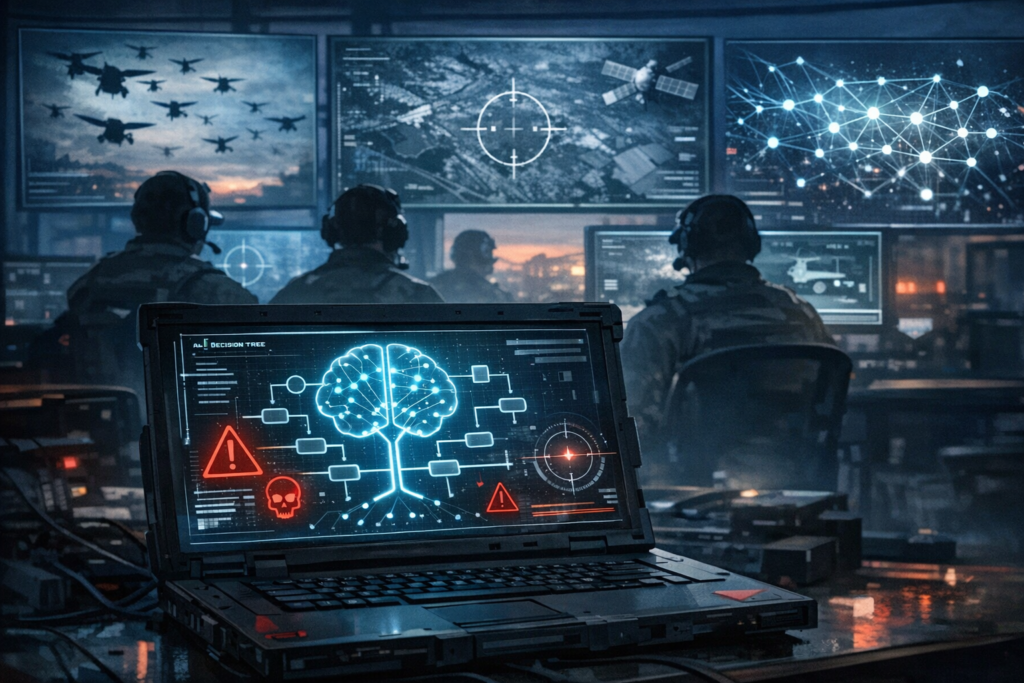
The rise of artificial intelligence in military operations is less a single revolution than a steady remaking of how forces sense, decide and act. From logistics hubs to combat airspace, AI systems are reshaping the battlefield rhythm — accelerating decision cycles, enabling new forms of autonomy, and rewriting the commercial and geopolitical ecosystem that supplies critical technologies. The result is a complex mix of tactical advantages, new vulnerabilities and hard policy choices about how far to automate violence and how nations will regulate the capabilities that enable it.
From sensors to decisions: where AI is actually being used
Modern militaries are deploying AI across a surprisingly broad set of missions. The most mature uses center on data-intensive, pattern-recognition problems:
- Intelligence, surveillance and reconnaissance (ISR): Machine learning turns streams from satellites, drones and ground sensors into fused situational pictures. Object detection, tracking and classification dramatically increase the volume of actionable targets operators can monitor.
- Electronic warfare and signals processing: Neural models improve signal identification, jamming detection and spectrum management, enabling faster responses across contested electromagnetic environments.
- Autonomy for air, sea and ground systems: From navigation and collision avoidance to cooperative behavior in swarms, autonomy layers reduce operator load and allow missions in denied or highly dynamic environments.
- Logistics and maintenance: Predictive maintenance models and optimized routing reduce downtime and sustainment costs, arguably delivering the largest peacetime ROI from military AI investment.
- Command support and decision aids: Assistive AI aggregates multi-domain data to recommend courses of action, model outcomes and surface high-risk options — though with varying levels of transparency.
These applications are not hypothetical; they are now fielded in limited ways by a number of states. The strategic objective is consistent: use AI to compress the observe-orient-decide-act loop, often summarized as OODA, so that forces operate at a tempo the adversary cannot match.
Human-machine teaming — not full automation — is the practical frontier
Talk of “killer robots” captures public attention, but the operational reality is more nuanced. Most militaries favor human-machine teaming over fully autonomous lethal decision-making. The reasons are pragmatic and political: ethical constraints, legal accountability, and the brittleness of models in novel tactical situations.
In practice, AI is increasingly used as an advisor or filter. It highlights relevant sensor feeds, ranks options, or autonomously performs low-risk actions (e.g., route replanning or airspace deconfliction) while leaving lethal force decisions to humans. This hybrid model delivers tempo and scale while maintaining a human check on use of force — at least on paper.
Where that model breaks down
Even with human-in-the-loop rules, latency, cognitive overload and ambiguous outputs can create de facto autonomy. If commanders rely routinely on an AI’s recommendations under time pressure, the human becomes a rubber stamp. Designing interfaces, audit trails and fail-safes that preserve meaningful human control is difficult but essential.
Industrial and commercial forces shaping military AI
AI for defense is not built in a vacuum. It rides the same tech rails as commercial AI: compute clusters, GPU suppliers, cloud providers, and open-source models. This has three strategic consequences:
- Commercial tech determines availability. Chips from a handful of suppliers (notably GPU makers) are a chokepoint. Export controls, supply shortages or targeted sanctions can slow a state’s AI fielding timeline.
- Dual-use ecosystems accelerate adoption. Defense programs increasingly buy tools and talent from the same firms serving enterprise AI — creating faster integration but also raising questions about rules of engagement for civilian platforms.
- Startups and primes compete and collaborate. Large defense contractors bring integration experience and scale; startups bring niche algorithmic advances and speed. Governments are funding both while also grappling with procurement reform to absorb fast-moving software updates.
Where commercial clouds host sensitive workloads, new architectures — air-gapped compute, hardened edge devices and specialized accelerators — are emerging to meet security and survivability requirements on the battlefield.
Risks: brittle models, adversarial threats and escalation dynamics
The operational gains of military AI come with unique risk categories:
- Model brittleness: Systems trained on peacetime or Western-locale data may misclassify unfamiliar platforms, decoys or tactics used by adversaries. Misidentification in a kinetic context has obvious and catastrophic consequences.
- Adversarial manipulation: ML models are vulnerable to spoofing and adversarial inputs — from doctored images to radio-frequency interference. In warfare, adversaries actively probe and manipulate AI perception chains.
- Supply chain and provenance risks: Compromised model weights or poisoned training data can introduce backdoors. The globalized supply chain for chips and software complicates trust.
- Escalation and strategic instability: Faster decision cycles increase the risk of rapid escalation, especially when both sides deploy semi-autonomous systems that misinterpret each other’s actions.
Addressing these risks requires rigorous testing, red-teaming, and new forms of certification that go beyond traditional software quality assurance.
Regimes, norms and the geopolitics of AI weaponization
International norms for military AI are nascent. Debates at the UN and multilateral forums focus on autonomous weapons systems and meaningful human control, but consensus remains elusive. Meanwhile, countries are moving forward unilaterally to develop doctrine that leverages AI advantages.
Export controls and sanctions are becoming tools of strategic competition. Restricting advanced compute or specialized chips can slow adversaries but also fractures the commercial market and complicates allied interoperability. Expect a patchwork of national rules, bilateral technology-sharing agreements, and regional standards rather than a single global treaty in the near term.
Paths forward: governance, engineering and operational practices
Three practical levers can make military AI safer and more effective.
1. Robust engineering and lifecycle management
Defense AI needs continuous validation across synthetic and real-world conditions. That means simulation environments that reflect adversary tactics, adversarial testing to uncover failure modes, and model governance that logs provenance and versioning. Edge devices should support secure model updates with attestation to prevent tampering.
2. Clear doctrine and calibrated autonomy
Doctrine must specify not only who decides but also when and how an AI can act autonomously. Operational rules of engagement should align with ethical and legal frameworks, and organizations should create escalation protocols when AI outputs are uncertain or contested.
3. Alliances and industrial strategy
Building coalition standards for interoperability — shared data formats, comms protocols, and safety certifications — will be as important as domestic regulation. At the industrial level, incentivizing resilient domestic supply chains for chips and trusted software through procurement and R&D funding reduces strategic vulnerabilities.
Scenarios that matter
How AI changes warfare will depend on how these levers are applied. Consider three plausible trajectories over the next decade:
- Measured integration: Nations adopt AI broadly for ISR, logistics and decision support with strict human-in-the-loop rules, strong verification regimes, and international standards. This reduces casualty rates and increases mission efficiency but keeps escalation risks moderate.
- Accelerated autonomy: Operational pressures and competitive dynamics push rapid adoption of semi-autonomous systems, swarms and AI-directed fires. Battlefield tempo increases, but so do incidents of miscalculation and fragile supply chains.
- Fragmented proliferation: Advanced AI tools proliferate to non-state actors and weaker states via the commercial ecosystem. This leads to asymmetric threats, contested urban environments with automated sensors and makes attribution harder.
None of these outcomes is predetermined. Policy, procurement choices and engineering practice will tilt the balance.
Final reflection: harnessing speed without surrendering judgment
AI fundamentally changes the character of military operations by multiplying the speed and scope of perception and action. The central challenge is governance: how to capture the operational advantages of high-tempo AI systems while retaining human judgment and accountability at critical decision points. That will require investment not only in algorithms and chips, but in human-centered interfaces, red-team testing, resilient supply chains and international norms that discourage reckless automation. The actors that succeed will be those who treat AI as an organizational transformation — combining technical rigor with doctrinal clarity and a willingness to harden the systems that now shape the modern battlefield.