
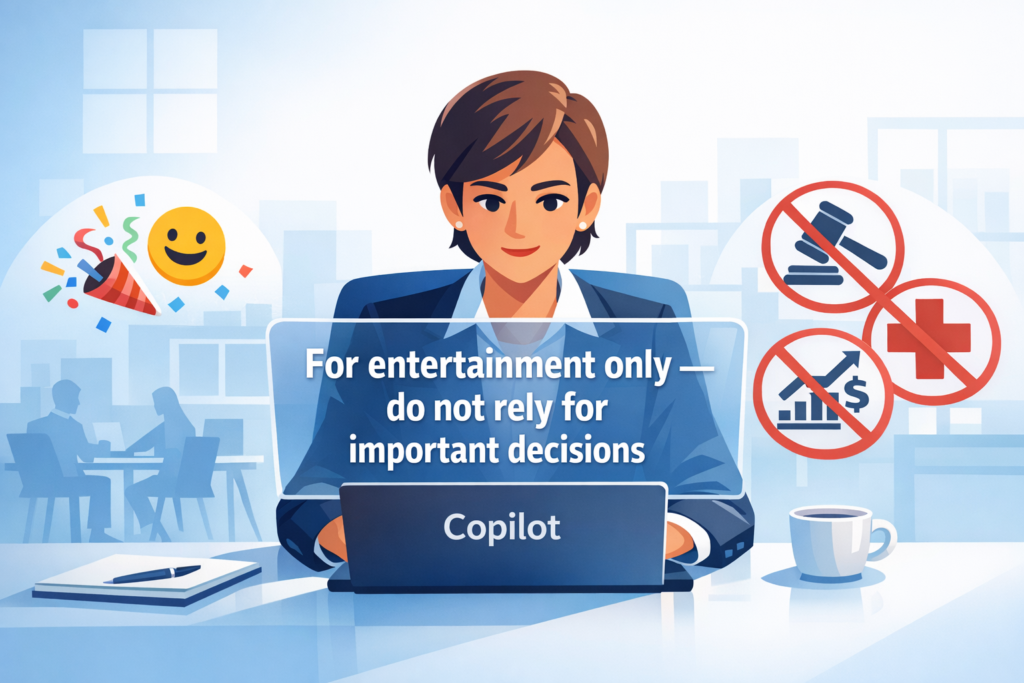
Microsoft’s public posture that “Copilot is entertainment-only, not for business use” reads like a strategic pivot and a risk-management memo rolled into one. For a company that has tied its cloud, productivity suite, and future growth to generative AI, an explicit internal or public caution about the reliability and intended use of a flagship AI assistant is a striking signal. It forces a reassessment: is this a narrow legal maneuver to limit liability, a careful product-positioning decision, or an early sign that Big Tech is waking up to the hard trade-offs of shipping large language models at scale?
When marketing meets legal reality
At first glance, the phrase “entertainment-only” seems at odds with years of Microsoft messaging that framed Copilot systems as productivity multipliers — drafting emails, summarizing meetings, generating code. Yet the term makes sense in a narrower context. Generative models are still prone to hallucination, can inadvertently reproduce copyrighted or private material from training data, and lack consistent factual grounding. For a company with customers’ critical business workflows in its hands, framing a consumer-facing Copilot as primarily for entertainment functions as a shield: it lowers user expectations, reduces contractual exposure, and clarifies the product’s intended risk profile.
This behavior isn’t unique to Microsoft. Across the industry, companies have used labeling, disclaimers, and segmented product offerings to manage regulatory expectations and legal liability. But for Microsoft — a dominant enterprise platform provider — the distinction between “consumer entertainment” and “business tool” is especially consequential. It sits at the intersection of product design, enterprise contracts, and regulatory scrutiny.
Why this stance now?
Several converging pressures explain why a major vendor would spell out such a limitation:
- Liability concerns: Generative outputs can produce inaccurate or infringing content. Explicitly limiting use cases narrows legal exposure.
- Regulatory climate: Global regulators are drafting rules around AI safety, copyright, and data protection. A cautious stance signals compliance-mindedness.
- Product maturity: Consumer Copilots often prioritize creativity and conversational fluency over determinism and auditability — traits that are acceptable for leisure but risky in mission-critical contexts.
- Customer segmentation: Microsoft sells different Copilot experiences: consumer, Windows, and Microsoft 365/enterprise variants. Distancing one from enterprise sets clearer product boundaries.
Implications for enterprises and IT leaders
For CIOs and data officers, Microsoft’s declaration is both a warning and an invitation. The warning: treat consumer-grade LLM instances as unvetted inputs and avoid feeding them sensitive corporate data. The invitation: work with enterprise-grade offerings that promise grounding, audit trails, and contractual protections.
Practically, that means organizations will increasingly demand the following from AI vendors:
- Deterministic retrieval and citation (RAG workflows that link outputs to verified documents)
- Data residency, encryption, and tenant isolation for model tuning
- Extensive logging and explainability for compliance audits
- Clear warranties, service-level agreements (SLAs), and indemnities regarding data use and IP risk
Those requirements push the market toward more modular architectures: foundation models as a service layered with enterprise-specific retrieval, filters, and governance tools. Microsoft can meet those demands through its Azure stack and Microsoft 365 integrations — but only if customers perceive a genuine difference between “consumer Copilot” and “enterprise Copilot.”
Product strategy and competitive positioning
Microsoft’s ecosystem strategy gives it levers no pure-play AI startup can fully replicate: control over Windows, Office, Azure, and enterprise identity. Still, warning that a flagship assistant is not suited for business use creates a quirk in messaging at precisely the time when trust is the central currency.
Competitors are watching. Google, Anthropic, OpenAI, and cloud providers are all racing to offer models with varying mixes of creativity, safety, and reliability. There are multiple viable approaches to address the trust problem:
- Ship specialized, heavily curated vertical models (legal, finance, healthcare) that are certified and auditable.
- Sell enterprise-hosted models where the customer retains control of training data and inference logs.
- Offer hybrid systems that use small local models for sensitive tasks and cloud models for broader reasoning.
Microsoft could choose any combination, but the short-term impact of the entertainment label is likely to push enterprise customers toward paid, tightly controlled Copilot variants or competitors promising stronger guarantees. That presents both a commercial risk and an opportunity: if Microsoft can credibly demonstrate that its enterprise Copilot is materially different in safety and compliance, it stands to capture more revenue and trust. If not, enterprise buyers will look elsewhere or build in-house.
Technical fixes and product investments that matter
Labeling alone won’t solve the underlying engineering problems. To convincingly make the consumer-versus-enterprise split sustainable, vendors need concrete technical measures that reduce the error surface of LLMs in business contexts. Key investments include:
- Grounding and provenance: Stronger retrieval-augmented generation with verifiable citations and sources tied to corporate knowledge stores.
- Model steering and guardrails: Safety layers that constrain tone, remove hallucinated facts, and prevent unsafe actions.
- Fine-tuning with private data: Secure fine-tuning pipelines that respect data residency and training consent.
- Explainable logging: Tools that map model outputs back to prompt fragments and knowledge sources for audits.
- Human-in-the-loop workflows: Integrated review systems for high-risk outputs (e.g., legal memos, medical recommendations).
These are not new ideas, but they are expensive and time-consuming to implement at scale. Enterprises will pay for them, but only if the vendor can back up promises with independent audits, certifications, and transparent practices.
Regulatory and legal fallout to watch
A bluntly worded entertainment disclaimer intersects with ongoing debates about AI regulation. Regulators are increasingly focused on:
- Whether vendors are transparent about training data and potential biases.
- How the attribution and copyright risks of generative outputs are managed.
- Consumer protection — does labeling a product “entertainment” absolve a vendor if users make consequential decisions based on its outputs?
Courts and regulators may test such disclaimers. If a product is heavily marketed with productivity narratives but legally labeled for entertainment, plaintiffs may argue the distinction is disingenuous. Conversely, explicit labeling could be seen as a mitigating factor in liability. The outcome will shape contract law and service-level commitments in AI for years to come.
Three realistic trajectories for Copilot and the market
1) Segmented Success: Microsoft clearly separates its consumer and enterprise Copilots. The consumer version remains a creative companion with relaxed accuracy guarantees, while the enterprise version evolves into a certified, auditable platform integrated across Azure and Office 365. Enterprise customers accept higher price points for greater guarantees.
2) Trust Erosion and Fragmentation: If the enterprise offering fails to demonstrate substantive safety upgrades, customers desert to rivals or build closed-source, on-prem solutions. The market fragments into vendor-controlled clouds, vertical specialists, and private-model ecosystems. Innovation continues, but at higher integration cost and slower pace.
3) Regulatory Realignment: Regulators impose strict requirements for any system used in certain decision contexts (healthcare, law, finance). That forces vendors to certify models, maintain provenance, and possibly switch to different liability models. Consumer copilots survive as casual tools but are explicitly barred from high-stakes uses in multiple jurisdictions.
What organizations should do now
For executives and practitioners, the Microsoft warning is a timely reminder to get pragmatic about generative AI risk management:
- Map the internal use cases where hallucinations or IP leakage could cause harm.
- Clearly separate experiments with consumer-grade tools from production workflows.
- Negotiate SLAs and data-protection clauses with vendors; demand logs and provenance when needed.
- Invest in internal governance — model cards, approval gates, and human review for high-risk outputs.
These measures won’t eliminate risk, but they will create guardrails that make AI adoption sustainable rather than speculative.
Final thought — a market in maturity
Microsoft’s warning reads as an inflection-point moment: the era of boundless marketing for generative AI is giving way to a phase of sober engineering and legal realism. That transition is healthy. It forces companies to stop pretending that a single model can be the answer to every problem and to start building layered systems that match technology capabilities to the consequences of error.
The long-term winners will be those that pair compelling generative capabilities with rigorous safety, clear accountability, and realistic product storytelling. For Microsoft and others, the question is not whether Copilots can be useful — they clearly can — but how to design, sell, and regulate them so that usefulness doesn’t come at the cost of trust.