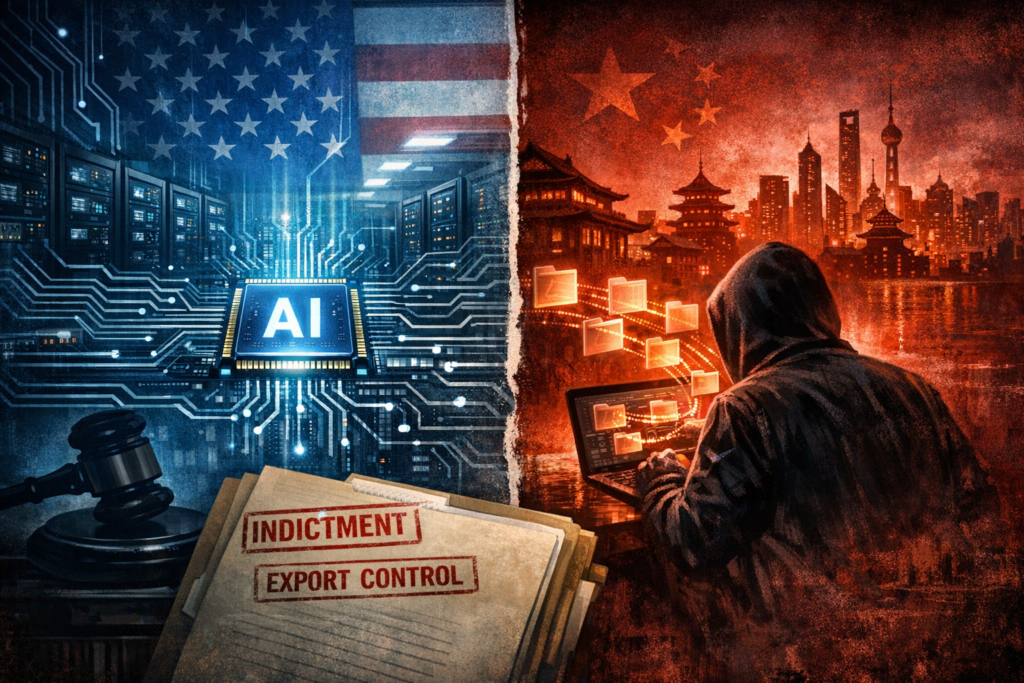
The recent criminal charges accusing three individuals of orchestrating a scheme to divert advanced U.S. artificial intelligence technology to China mark more than a law-enforcement moment — they reveal how the geopolitics of semiconductors and AI are being fought not only in boardrooms and labs but across logistics chains, shell entities and research partnerships. For an industry racing toward more powerful models and specialized chips, this episode is a reminder that intelligence in the machine-learning era must be matched by intelligence in risk management, export compliance and national strategy.
A clandestine channel for compute
The core allegation is straightforward: actors bypassed export controls and sanctions to move high-performance AI hardware, expertise and related components out of the United States through intermediaries — erasing digital footprints, mislabeling shipments, and leveraging third-party businesses to obscure the true destination. This pattern — of sourcing components in permissive jurisdictions, repackaging them, and routing them through complex corporate networks — is how restricted dual-use technologies can be circulated despite tightening rules.
What makes this dangerous is that the commodity in question is not a widget but compute power: specialized processors, interconnects, and the systems engineering know-how that enable training of advanced AI models. Those assets are catalytic. A single container of high-end accelerators can compress years of research and millions of dollars of cloud spend into an instant capability jump for an organization that previously couldn’t afford or access such resources.
Why hardware is the choke point
For now, access to specialized semiconductors and integrated systems remains the most effective choke point for controlling who can train and deploy frontier AI. Software can be shared, and models can be downloaded. But at scale, those models need high-bandwidth, low-latency accelerator clusters and the associated infrastructure engineering. Export controls therefore focus on the compute layer — chips, sophisticated boards, cooling and power systems, and even certain IP — because these components are hard to replicate quickly at scale.
Strategic faultlines: industry, national security, and innovation
This prosecution sits at the intersection of three trends reshaping the AI landscape.
- Decentralized innovation: AI progress increasingly stems from globalized R&D ecosystems. Hardware is designed in one country, manufactured in another, and assembled across a third. This geographic dispersion creates both resilience and opportunities for circumvention.
- Regulatory tightening: Governments worldwide are aligning export controls around sensitive AI-enabling technologies. Enforcement actions send a message to would-be intermediaries that the old playbook of cloaking destination and intent will face legal consequences.
- Commercial incentives to share and conceal: Startups and research labs in constrained markets have strong incentives to acquire compute capacity by any means. On the other side, front companies and intermediary brokers can profit significantly by enabling those transfers.
The confluence exacerbates the classic tension: how to protect national-security interests without fragmenting the global innovation ecosystem that has powered AI’s rapid advance.
Enforcement as policy lever — what to expect next
Prosecutions like this have effects beyond criminal deterrence. They sharpen the tools available to regulators and shape corporate behavior in ways that will outlast any single case.
Near-term consequences are likely to include:
- Heightened scrutiny of supply chains by customs and export authorities, with more audits and targeted inspections at ports and logistics hubs.
- Deeper collaboration between government intelligence units and private-sector compliance teams, using trade data and anomaly detection to spot suspicious routing patterns.
- Acceleration of measures that reduce ambiguity about classification of AI-related goods — which chips, interconnects, and integrated systems fall under export controls — giving firms clearer rules but also narrower paths for legitimate commerce.
Longer-term, expect nations that rely on restricted supplies to either seek indigenous production capacity or develop elaborate workarounds, including local manufacturing of banal components that, when assembled with clever engineering, approximate restricted functionality. That dynamic increases pressure for both technological and industrial-policy responses.
Business risks and reputational contagion
Beyond legal exposure for the individuals involved, the broader ecosystem faces reputational and financial risk. Cloud providers, chipmakers and integrators can be affected in multiple ways:
- Contractual and insurance liabilities if their components are diverted — even indirectly — into illicit channels.
- Investor and customer backlash as clients demand assurances that their suppliers comply with export controls and ethical guidelines.
- Operational disruption if customs seizures and sanctions slow down deliveries of critical components, leading to production delays and model training pipelines sputtering.
For AI startups, the incident is a powerful reminder that cutting corners on compliance to chase compute parity is a false economy. The risk of indictment, asset seizures and collapsed partnerships often outweighs short-term gains.
Technical controls and corporate governance — not just legal defenses
Companies that design, integrate, or distribute AI-enabling hardware must move beyond checkbox compliance. Practical, layered defenses include:
- End-to-end provenance tracking for hardware — embedding secure identifiers and immutable supply-chain records that are audited regularly.
- Robust trade-compliance programs combining human expertise and analytics to flag unusual orders, shipping anomalies, and suspicious corporate ownership structures.
- Operational constraints in sales contracts restricting redeployment of hardware, paired with remote telemetry (where lawful) to ensure gear remains in approved jurisdictions.
These measures are not foolproof, but they raise the bar for covert transfers and help multinational firms demonstrate good-faith efforts to abide by export rules.
Three plausible trajectories for the next five years
How this episode influences the AI-industrial competition depends on policy responses, market incentives, and technology diffusion. Here are three plausible futures.
1. Managed bifurcation
Governments coordinate tighter export regimes focused on the most advanced nodes and integrated systems while allowing civilian-grade components freer movement. The result is a semi-fragmented global market: high-end AI development concentrates in a handful of allied countries, but research at non-frontier scales remains broadly international. This scenario favors large cloud providers and semiconductor champions with vertically integrated production.
2. Competitive decoupling
Escalating restrictions prompt strategic decoupling. Countries invest heavily in domestic foundries and specialized AI hardware ecosystems. Short term costs are high due to duplication of capacity, but after a decade, parallel innovation hubs emerge — each advancing different architectures and ecosystems. This reduces the risk of illicit transfers but increases global inefficiency and slows the pace of shared breakthroughs.
3. Agile workaround ecosystem
Actors develop sophisticated legal and quasi-legal channels — third-country assembly, reclassification of parts, biodefense-style procurement strategies — to evade controls. Enforcement becomes a cat-and-mouse game, requiring constant adaptation by regulators and firms. Innovation continues to diffuse but under a shadow economy that complicates policy and compliance.
What responsible industry actors should do now
For executives and technical leaders, the practical calculus is immediate and operational.
- Audit: Rapidly inventory where critical hardware and design IP flows in your supply chain and who controls those nodes.
- Invest: Allocate resources to compliance teams and provenance technology now, not later — the cost of retrofitting controls after an incident can dwarf proactive spending.
- Engage: Work with regulators to clarify grey areas in export rules. Constructive dialogue reduces regulatory surprises and helps design workable compliance frameworks.
- Design: Rethink product capabilities and licensing models to decouple sensitive features from commoditized hardware where feasible.
Broader reflections: sovereignty, innovation, and the ethics of compute power
What this prosecution crystallizes is that compute — once abundant and inexpensive in a cloud-dominated world — is now a strategic asset. Control over compute shapes who can experiment at scale, who can field advanced models, and who can influence the norms around AI deployment. Policymakers face a difficult balancing act: safeguarding national security without strangling the collaborative, cross-border research that propels AI forward.
For technologists and business leaders, the call to action is clear. Ethical stewardship of AI must now include stewardship of the physical infrastructure underpinning models. That means designing systems and business practices that anticipate adversarial behavior, prioritize resilient and transparent supply chains, and partner with governments to create frameworks that are enforceable and equitable.
Ultimately, incidents like this will not halt the AI arms race — they will change its geography and governance. The industry’s challenge is to channel competitive energy into architectures, policies and alliances that make innovation safer and more sustainable. The alternative is a patchwork of workarounds, enforcement battles and strategic setbacks that undermine both security and progress.