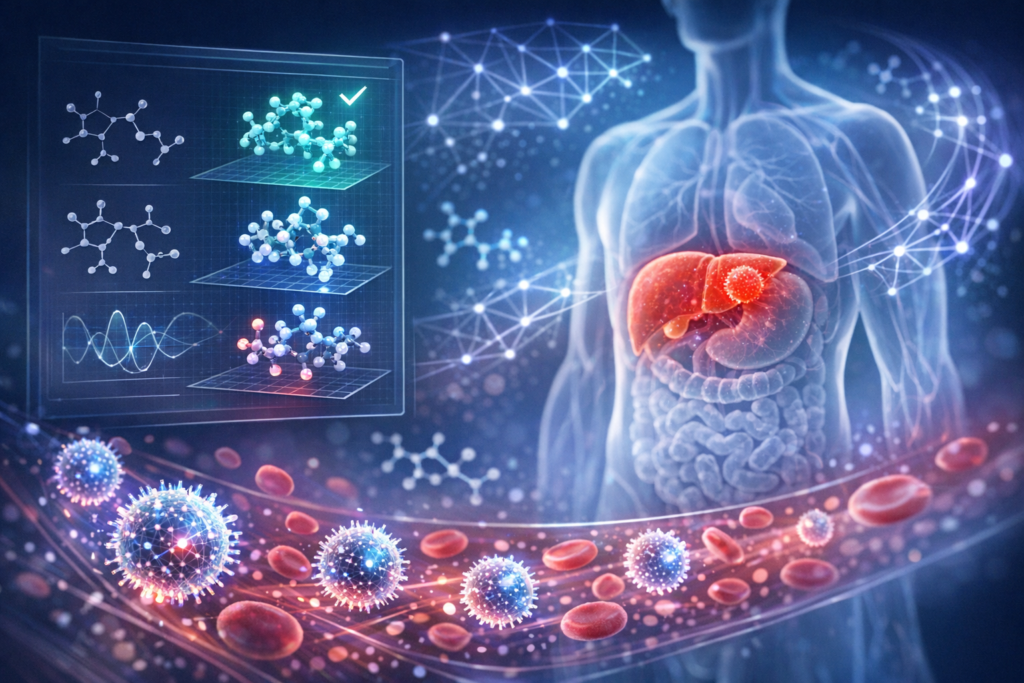
The ability to ferry therapeutic mRNA into specific cell types inside a living organism has been the bottleneck holding back much of the promise of nucleic acid medicines. Recent advances that combine machine learning with modern nanoparticle chemistry are changing that calculus: AI-guided lipid nanoparticle (LNP) design is beginning to deliver targeted mRNA payloads in vivo, not just to the liver or muscle, but to specific tissues and cell types. That’s more than an incremental technical improvement — it reframes how drug delivery platforms are conceived, built, and commercialized.
Why delivery has always been the hard problem
mRNA therapies are elegant in concept: encode a therapeutic protein or gene editor, package it, inject, and let the body produce the medicine. In practice, however, the biological barriers between injection and target cell are complex and context-dependent. Nanoparticles must survive circulation, avoid immune clearance, cross endothelial barriers, enter the right cell type, and release cargo without provoking a harmful response. Small chemical tweaks in the lipid composition of a nanoparticle can make the difference between efficient, cell-type specific delivery and systemic toxicity.
Historically, LNP design relied on chemical intuition and incremental screening. The COVID-19 vaccines catalyzed progress by demonstrating that LNPs could be safe and effective at scale for systemic dosing, but targeted delivery to specific organs or cell populations remained elusive. That is the gap AI-guided approaches are now attacking.
What AI brings to nanoparticle design
Machine learning changes the game in two complementary ways. First, it can model the high-dimensional relationship between lipid chemistry, particle physical properties, and in vivo biodistribution — a mapping too complex for human intuition alone. Second, AI enables closed-loop experimentation: models propose novel lipid structures, automated synthesis and high-throughput in vivo assays evaluate them, and the data rapidly refine the next generation of designs.
Practically, this looks like iterations of combinatorial chemistry and massively parallel in vivo screens, sometimes using molecular barcodes or single-cell readouts, paired with generative models that search chemical space for candidates predicted to target particular tissues or cell phenotypes. Active learning methods prioritize experiments that most reduce model uncertainty, accelerating convergence toward functional LNPs. The result is not merely better particles; it’s an entirely different R&D cadence — faster, data-driven, and less dependent on serendipity.
Beyond prediction: more efficient creative search
Generative models and optimization techniques let researchers explore lipid architectures that would never be considered in a classic medicinal chemistry pathway. These models can propose non-intuitive combinations of headgroups, hydrophobic tails, and helper lipids that achieve specific delivery profiles. By focusing experimental effort on the most promising designs, AI reduces both time and reagent costs.
Strategic implications for the AI and biotech industries
The rise of AI-driven delivery platforms will reshape competitive dynamics across biotech and pharma. There are three immediate strategic shifts to watch:
- Platform economics trump single-product bets. A validated AI-LNP platform is valuable across multiple modalities: mRNA replacement, CRISPR editing, siRNA, and therapeutic peptides. Firms that build robust discovery-to-manufacturing pipelines will command premium multiproduct valuations.
- Vertical integration accelerates value capture. Success requires not only algorithms but high-throughput wet labs, microfluidics, GMP manufacturing, and regulatory expertise. Expect partnerships between AI-first startups and legacy pharma/CDMOs or acquisitions that stitch those capabilities together.
- New entrants blur the line between tech and biotech. Machine learning companies familiar with generative chemistry and closed-loop optimization are moving downstream into biology. Conversely, biotech firms are hiring ML talent to internalize these capabilities.
Risks and friction points — technical, regulatory, and ethical
Despite promise, AI-guided LNPs face real constraints.
Translatability from animals to humans
Much of the early success in targeted delivery has been demonstrated in small animal models. Human physiology — endothelial composition, immune surveillance, and biodistribution patterns — often differs substantially. Models must therefore incorporate cross-species variation or be retrained on human-relevant data, such as ex vivo tissues, organoids, or humanized animal systems.
Safety and immunogenicity
Optimizing for delivery could inadvertently heighten immunostimulation or long-term toxicity. Safety signals sometimes emerge only after prolonged dosing or in specific patient populations. Regulators will demand rigorous mechanistic and toxicology data for novel lipid chemistries.
Manufacturing and quality control
LNPs are complex assemblies. Ensuring batch-to-batch consistency, scalable synthesis of novel lipids, and robust downstream purification are nontrivial engineering problems. Quality-by-design principles and digital twins of manufacturing lines will likely be required to satisfy regulators and payers.
Biosecurity and dual-use concerns
As delivery barriers fall, the potential for misuse grows. Easier access to in vivo delivery platforms heightens dual-use risk profiles, demanding oversight, transparent collaboration between industry and regulators, and responsible publication norms for certain classes of research.
Opportunity spaces: where targeted LNPs will matter most
AI-guided targeting opens several attractive therapeutic and commercial lanes:
- Systemic gene editing — Precise CRISPR delivery to specific cell populations could enable curative interventions for genetic diseases without ex vivo manipulation.
- Oncology — Delivering mRNA or immune modulators directly to tumor-associated cells or tumor-infiltrating lymphocytes can amplify anti-tumor immunity while minimizing systemic toxicity.
- Rare disease therapies — Targeted dosing reduces the amount of expensive nucleotide payload needed, making treatments for ultra-rare conditions more economically viable.
- Respiratory and CNS delivery — Optimizing for local penetration could unlock inhaled vaccines and therapeutics or new ways to cross the blood-brain barrier.
Competitive dynamics and potential market moves
Given the platform nature of delivery technology, expect a mix of strategic plays:
- Large pharma acquisition of AI-driven delivery startups to secure platform control.
- Licensing deals that let smaller biotech companies plug optimized LNPs into their therapeutic payloads.
- Emerging service providers offering “discovery-as-a-service” combining AI, synthesis, and in vivo screens for academic labs and startups.
Who wins will depend on more than algorithms. Firms that build seamless workflows from model training to validated, GMP-ready lipid production and that can demonstrate reproducible human translation will dominate commercial outcomes.
What success looks like — three trajectories
Projecting forward, three plausible near-term paths emerge:
1. Rapid maturation and platform dominance
AI-driven design yields several clinically validated, targeted LNPs within a few years. Startups scale through partnerships and acquisitions, and a handful of platforms become standard suppliers for mRNA and gene-editing payloads. Product pipelines accelerate, and novel indications become commercially viable.
2. Incremental gains with regulatory drag
AI improves preclinical selection but translation is slower than hoped. Regulators impose conservative requirements for novel lipid chemistries. Progress continues but at a measured pace, favoring incumbents with deep clinical experience.
3. Fragmentation and ethical backlash
Early missteps—safety issues or mishandled research—trigger stricter oversight and public skepticism. Development becomes harder, favoring well-resourced actors and slowing democratization.
Technical priorities for the next wave
To realize the optimistic scenarios, several technology investments are essential:
- Integrating multi-scale modeling that couples molecular dynamics, protein interactions, and organ-level pharmacokinetics.
- Standardizing high-throughput in vivo assays and barcoding strategies to create interoperable datasets.
- Advancing explainable models that illuminate why a lipid works, not just that it does — easing regulatory acceptance.
- Building modular manufacturing solutions that can quickly produce GMP-grade novel lipids at scale.
A final thought on convergence
AI-guided LNPs sit at the nexus of computation, chemistry, and biology. Their success will be judged not by an elegant model or a headline study, but by whether they enable safer, more precise medicines that reach patients faster and at lower cost. That requires more than better algorithms: it requires engineering, regulatory savvy, and a culture of responsible development.
If the community gets that mix right, we could be witnessing the emergence of a new class of therapeutics — not just because an AI made a discovery, but because AI changed how discoveries are found, validated, and delivered into the human body.