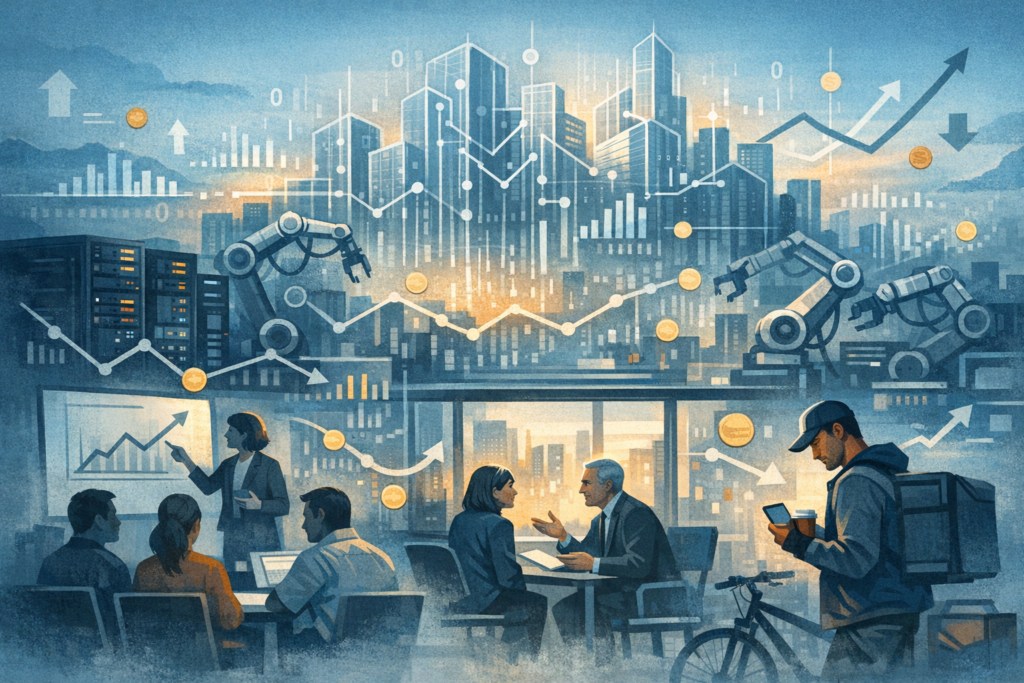
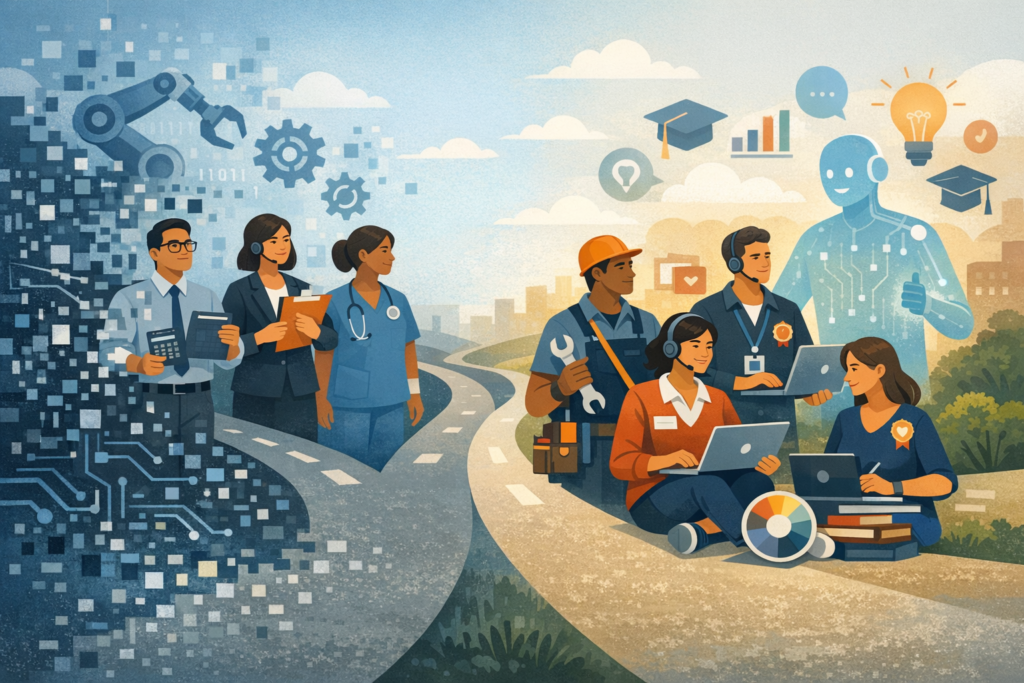
The conversation about artificial intelligence and employment has shifted from abstract futurism to immediate workforce strategy. As generative AI, advanced machine learning, and increasingly capable automation systems move from labs into enterprise workflows, leaders and workers face a simple, urgent question: which jobs are most exposed to displacement, and who can realistically adapt to stay valuable?
Why some jobs are more vulnerable than others
It helps to think in terms of tasks, not job titles. Modern AI systems excel at pattern recognition, prediction, and routine language or image generation — especially when the tasks are well-defined, data-rich, and repeatable. Jobs built around such tasks are therefore the most exposed.
Key vulnerability factors include:
- Repetitive, rules-based tasks that can be codified;
- High volumes of digital data available to train models (text, code, images, transactions);
- Low requirement for nuanced social judgment, empathy, or unpredictable physical dexterity;
- Economic incentives to substitute labor with software rather than augment it.
When a role scores high on these dimensions — for example, processing invoices or categorizing images — it becomes prime territory for automation. Conversely, roles that rely on ambiguous social contexts, deep physical adaptability, or long-tail creativity are more resilient.
Categories at greatest risk
Administrative and clerical work
Routine office tasks — data entry, scheduling, basic bookkeeping — are classic candidates for automation. Advances in natural language processing and workflow automation mean that software bots and AI assistants can parse emails, populate spreadsheets, reconcile accounts, and even generate standard reports with minimal human oversight.
Customer service and first-line support
Chatbots and voice assistants are already handling a growing share of inbound queries. As conversational models improve, they can resolve increasingly complex interactions, route cases intelligently, and redact sensitive information. This reduces demand for large teams of entry-level agents, although escalation points and relationship management remain human domains.
Content production and basic creative labor
Generative AI can draft marketing copy, summarize articles, create simple images, and produce synthetic media. For standardized content — product descriptions, templated reports, routine news briefs — AI offers cheaper and faster alternatives. The risk is twofold: displacement of repeatable creative tasks and a flood of low-cost content that compresses rates for human creators.
Transportation and routine logistics
Self-driving systems and automated warehouses threaten roles built around predictable routes and controlled environments. While fully autonomous freight and passenger transport are technically and socially complex, incremental automation in warehousing, route optimization, and last-mile delivery is already reshaping demand.
Transactional finance and basic analysis
Algorithms can now detect anomalies, generate financial reports, and perform initial credit assessments. Entry-level financial analysts and loan officers, whose work centers on pattern-based risk assessments and routine modeling, face medium-term pressure as firms deploy AI to scale decision pipelines.
Who can adapt — and how
Adaptability is less about avoiding automation entirely and more about shifting toward activities that play to uniquely human strengths. Workers and organizations that can combine domain expertise with AI literacy will fare best.
Adaptable profiles typically share several traits:
- T-shaped skillsets: Deep expertise in a domain plus broad familiarity with AI tools and data reasoning;
- Complex social skills: Empathy, negotiation, mentoring, and leadership that machines can’t replicate convincingly;
- Creative judgment: The ability to frame problems, curate meaning, and synthesize disparate inputs into original insight;
- Technical stewardship: Roles that supervise, fine-tune, and integrate AI systems — prompt engineering, model validation, data curation;
- Operational flexibility: Willingness to move between tasks and learn new tooling as workflows change.
Examples of roles likely to adapt successfully include product managers who learn to orchestrate AI features, healthcare professionals who leverage decision-support models while retaining patient-facing judgment, and creative directors who use generative tools to iterate faster while maintaining artistic oversight.
Strategic context: firms, markets, and power dynamics
Companies see AI as a lever for scaling expertise and lowering marginal costs. Early adopters capture efficiency gains, reallocate headcount to higher-value work, and potentially outcompete rivals who move slowly. This creates a competitive cascade: as more firms automate, the productivity bar rises, pressuring laggards to follow suit or lose market share.
However, automation isn’t a free-for-all. Organizational capability — data infrastructure, engineering talent, change management — determines who wins. Businesses that treat AI as augmentation toolkit rather than headcount arbitrage tend to see better morale and sustained value creation. Conversely, firms focused solely on short-term cost reduction risk eroding institutional knowledge and customer relationships.
SMBs versus hyperscalers
Large tech firms and well-capitalized incumbents can train proprietary models, buy startups, and integrate AI at scale. Smaller businesses may rely on third-party APIs and pre-trained models, which democratizes access but introduces dependency and potential vendor lock-in. The net effect is a two-speed economy where platform control and data ownership become strategic assets.
Regulatory and societal consequences
Broad adoption of AI in the workplace raises questions beyond efficiency. Regulators must grapple with worker displacement, algorithmic fairness, liability for automated decisions, and the pace of transitions. Policy responses could include targeted retraining programs, wage subsidies for jobs that require human contact, stronger safety nets, or rules limiting the use of AI in certain high-stakes domains.
Data governance also matters. When AI systems make employment decisions — screening resumes or scoring performance — transparency and contestability will be essential to prevent biased outcomes. Certification regimes for models used in employment, finance, or medicine may emerge as governments and standards bodies codify expectations for explainability and auditability.
Three plausible trajectories
1) Augmentation-led growth
Organizations adopt AI to augment workers, boosting productivity and creating higher-skilled roles. Education systems and employers invest in reskilling, and policy supports transitions. Unemployment remains manageable as roles evolve rather than vanish.
2) Uneven disruption
Adoption is widespread but uneven. Some sectors and regions gain disproportionate benefits, while others face concentrated job losses. Social and political pressure grows for redistribution and regulatory interventions. Fragmented labor markets increase inequality but also spark new industries around AI oversight and creativity.
3) Rapid restructuring with social strain
Accelerated automation displaces large swaths of routine work before adequate retraining or safety nets are in place. Short-term unemployment spikes; political backlash leads to stringent regulations or protectionist measures. Economic growth continues, but social costs rise significantly.
Practical steps for stakeholders
Businesses should map tasks, not just roles, to identify automation potential and invest in transition plans that pair technology with human upskilling. Workers need accessible learning pathways that teach AI literacy, data reasoning, and soft skills. Educators and trainers must pivot to modular, lifelong learning models that align with employer needs. Policymakers should prioritize targeted retraining, portable benefits, and regulatory frameworks that ensure accountability for automated decisions.
Concretely:
- Audit workflows to separate routinizable tasks from high-value judgment work;
- Deploy AI pilots that include human-in-the-loop evaluation and measurable impact metrics;
- Create public-private retraining partnerships focused on domain-specific AI applications;
- Establish transparency standards for hiring and performance systems powered by AI.
Final reflection: shaping an adaptive labor market
AI’s disruption is neither uniformly destructive nor uniformly benevolent. The technology will remove some tasks, create others, and transform many more. The critical variable is human agency — how companies choose to deploy AI and how societies choose to support transitions.
Workers who cultivate complementary skills — deep domain knowledge, judgment, social intelligence, and a willingness to learn new interfaces with AI — will be best positioned. Employers that view AI as a force multiplier for people, invest in upskilling, and design workflows around human strengths will capture long-term advantage. Regulators that balance innovation with protections for fairness and accountability can mitigate harm while enabling productive diffusion.
Ultimately, the next decade will test our ability to reframe work around human potential in an age of intelligent machines. Preparing for that future is not a single policy or technology decision; it is a sustained commitment to reskilling, thoughtful governance, and organizational design that prizes human judgment as the core asset AI should amplify.