Generative AI has made it trivial to create convincing images of people who don’t exist—or to fabricate explicit imagery of real people who never consented. When that capability is aimed at children, the harm is immediate, the investigative burden is high, and the legal system often struggles to keep pace. That’s why Iowa’s latest legislative push to criminalize AI-generated obscene depictions of minors is more than a local headline: it’s a signal that state lawmakers are moving to close a dangerous gap in child-exploitation law as synthetic media becomes mainstream.
What Happened: Iowa Moves to Criminalize AI-Generated Obscene Images of Minors
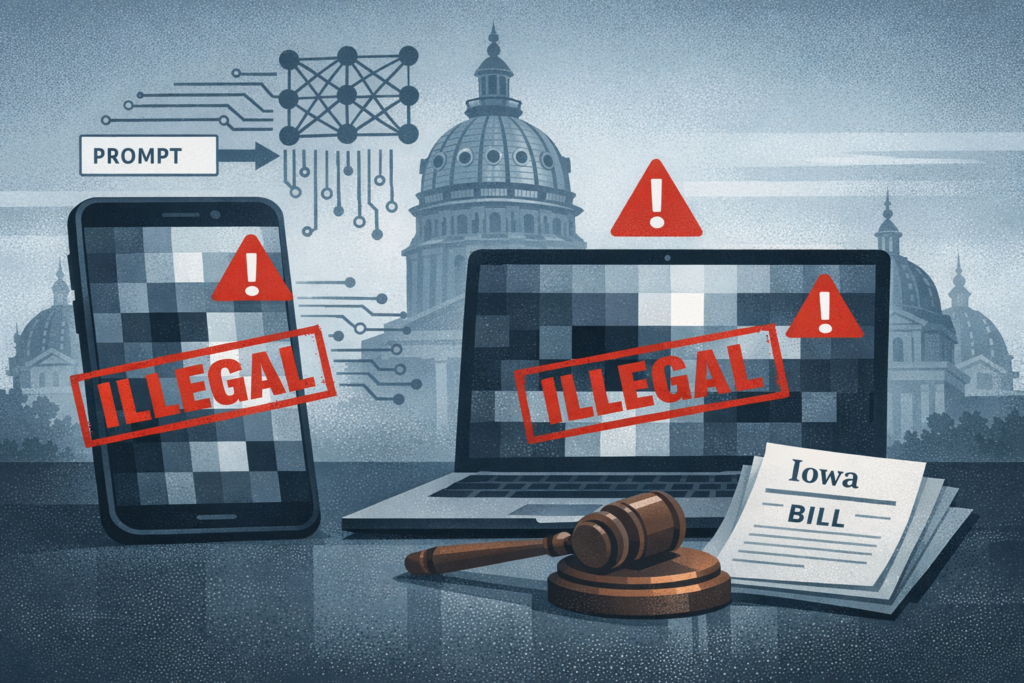
Iowa lawmakers are advancing a bill designed to crack down on the creation and distribution of obscene, AI-generated images depicting minors. The intent is straightforward: ensure that “synthetic” or computer-generated child sexual abuse material (CSAM)—including deepfakes and other photorealistic outputs—doesn’t escape prosecution simply because no physical child was directly photographed.
This type of legislation typically targets several behaviors:
- Creating AI-generated obscene depictions of minors
- Possessing such content (with defined thresholds and intent standards)
- Distributing or sharing the material, including via social platforms and messaging apps
While details such as definitions, penalties, and evidentiary thresholds depend on the final bill text, the core policy direction is clear: Iowa wants its criminal code to treat synthetic child-exploitation imagery with the seriousness it warrants, even when the imagery is not a direct recording of abuse.
Why This Matters: The Legal Gap AI Opened
Historically, laws against sexual exploitation of children were anchored to a physical reality—images and videos captured from real abuse. Generative AI disrupts that assumption. Today, someone with consumer hardware and widely available models can generate convincing explicit images in minutes, sometimes by:
- Generating a fully synthetic “person” who appears underage
- “Nudifying” a clothed photo (often sourced from social media)
- Face-swapping a real child’s face onto an explicit body
- Using text-to-image prompts to produce abusive scenarios
Even when no camera was involved, the damage is real. Victims can be identified, bullied, extorted, or psychologically harmed. And for law enforcement, synthetic media introduces new complexity: provenance is harder to prove, and platforms can be overwhelmed by volume.
Iowa’s bill reflects a broader shift toward regulating harmful outputs and use cases—not just the underlying AI models.
Implications for the AI Industry: From Model Governance to Output Liability
1) Safety Requirements Are Becoming a Competitive Necessity
AI companies often frame safety as an ethical obligation. In practice, it’s rapidly becoming a compliance and market-access requirement. State laws like Iowa’s increase pressure on vendors to demonstrate:
- Robust content filters for sexual content, especially involving minors
- Prompt and image moderation with clear escalation policies
- Abuse monitoring and mechanisms to deter repeat offenders
- Transparency in how a model handles disallowed content
For model providers, the risk is no longer just reputational. It’s operational: subpoenas, incident response, and potential claims that a platform facilitated illegal content due to negligent safeguards.
2) “Open” vs. “Controlled” Distribution Will Diverge Further
This legislation adds momentum to a trend already underway: controlled-access models (API-based, logged, monitored) generally have an easier path to showing diligence than fully downloadable models with minimal guardrails.
That doesn’t mean open-source disappears—but it may migrate toward:
- More stringent licensing
- Default safety tooling bundled into pipelines
- Greater emphasis on watermarking and provenance standards
- “Responsible release” norms where high-risk capabilities are gated
Expect a widening compliance gap between enterprise AI platforms and hobbyist ecosystems, with regulators increasingly expecting platforms to anticipate misuse.
Who Benefits—and Who Is Threatened
Beneficiaries
- Children and families: Stronger deterrence and a clearer legal mechanism to pursue perpetrators.
- Schools and youth organizations: Better alignment between policy and the reality of AI-enabled harassment and sextortion.
- Platforms that invest in safety: Companies with serious moderation and provenance tooling can differentiate on trust and risk management.
- Investigators: Clearer statutes reduce ambiguity when synthetic content is involved.
Threatened stakeholders
- Bad actors: Individuals using AI to create exploitative content face increased legal exposure.
- Platforms with weak safeguards: Services that allow image generation or sharing without strong controls may face higher compliance costs and legal scrutiny.
- Creators operating in gray zones: People producing “adult-looking but underage-coded” content will find it harder to claim ambiguity as definitions tighten.
Importantly, legitimate artists and AI developers may worry about overreach. The legislative challenge is to define “minor” depictions and obscenity precisely enough to target exploitation without criminalizing lawful art, education, or medical content.
Market Implications: Safety Tech Becomes a Growth Sector
As states update laws around deepfakes and synthetic sexual content, demand will rise for AI safety infrastructure. Several categories are positioned for growth:
- CSAM detection and hashing: Tools that identify known illegal imagery and patterns, adapted for AI-generated variants.
- Provenance and watermarking: Systems that mark generated content and help trace origin (e.g., C2PA-style metadata).
- Content moderation automation: Multimodal classifiers capable of flagging sexual content, age cues, and manipulation artifacts.
- Trust and safety operations: Managed services supporting incident response, reporting, and compliance.
For enterprise buyers—especially social platforms, messaging tools, gaming communities, and creator marketplaces—this legislation reinforces a procurement reality: vendors will increasingly be vetted on harm prevention as much as capability.
Business Impact: What Companies Should Do Now
If your product touches image generation, image editing, social sharing, or user-generated content, Iowa’s move is a reminder to harden policies and systems.
Practical steps for AI and platform teams
- Update acceptable-use policies to explicitly prohibit AI-generated sexual content involving minors, including “synthetic” depictions.
- Strengthen age-related safeguards in both prompts and outputs; increase friction for suspicious requests.
- Implement layered detection: prompt filtering + output classifiers + user reporting + human review.
- Log and retain metadata responsibly to support investigations while respecting privacy and security.
- Prepare a law-enforcement response playbook (subpoenas, preservation requests, and escalation paths).
Businesses that treat this as an edge case will be surprised by how quickly it becomes a board-level concern—especially as insurers, payment processors, and app stores scrutinize risk.
Real-World Use Cases: How AI-Generated Abuse Manifests
It’s tempting to treat synthetic CSAM as a purely “online” issue, but the harm often begins with real-world access to a child’s image—frequently from ordinary places like school events or social media.
Use case 1: School harassment and reputational harm
A student’s yearbook photo is scraped and transformed into explicit imagery circulated through group chats. Even if peers know it’s fake, the social consequences can be severe and long-lasting.
Use case 2: Sextortion enabled by synthetic images
Bad actors generate explicit images and threaten to “leak more” unless a victim pays money or provides real sexual content. The synthetic image functions as a coercive anchor.
Use case 3: Grooming pipelines and normalization
Communities that trade synthetic images can normalize exploitation, creating stepping stones toward real abuse and expanding the market for harmful content.
Iowa’s legislative approach is aimed at stopping these cycles earlier—before synthetic content becomes a low-risk on-ramp for exploitation.
What Comes Next: Predictions and Expert Commentary
From an AI industry analyst perspective, Iowa’s bill fits into an emerging pattern: states will keep legislating around specific high-harm AI applications—deepfake sex abuse, election deception, fraud—often faster than federal consensus can form.
Prediction 1: More states will align definitions around synthetic sexual content
Expect a patchwork in the short term, but increasing convergence around: “digitally created or altered,” “indistinguishable from a real minor,” and “intent to arouse or gratify” language. Companies operating nationally will need a “highest common denominator” compliance strategy.
Prediction 2: Provenance tooling will move from “nice-to-have” to baseline
Watermarking and content credentials won’t stop abuse on their own, but they will become a standard expectation in enterprise deployments—especially for products that generate or edit images.
Prediction 3: Litigation risk will push platforms toward stricter controls
Even when platform immunity doctrines apply, the business cost of investigations, PR crises, and regulator attention is substantial. Many services will choose more conservative filters and higher friction for image-generation features.
Prediction 4: Trust & Safety will gain budget and influence
Teams once seen as cost centers will be reframed as risk-management and revenue-protection units, particularly for consumer AI apps.
FAQ
Does the law target “deepfakes” only, or any AI-generated explicit depiction of minors?
These bills generally aim broader than face-swaps. They typically cover any synthetic or AI-generated obscene depiction of a minor, including fully generated images.
How can law enforcement tell if an image is AI-generated?
Detection can involve metadata analysis, model artifacts, forensic signals, and investigative context. However, many laws focus on the depiction and intent rather than requiring proof of the exact generation method.
Will this affect legitimate AI art or education content?
Well-drafted statutes are designed to focus on obscene sexual depictions involving minors. The key is precise definitions and clear intent standards to avoid sweeping in lawful content.
What should AI companies do to reduce risk?
Adopt layered safety controls: strict policy, strong filtering, monitoring, reporting channels, and incident response. Also consider provenance/watermarking and careful access controls for high-risk capabilities.
Conclusion
Iowa’s crackdown on AI-generated obscene images of minors is a concrete example of law catching up to generative AI’s most dangerous misuse cases. For families and communities, it signals stronger deterrence and clearer accountability. For the AI industry, it reinforces a hard truth: capability without governance becomes liability. Companies that invest now in safety-by-design, provenance, and operational readiness won’t just reduce harm—they’ll be better positioned for the regulatory reality that’s rapidly taking shape across the U.S.