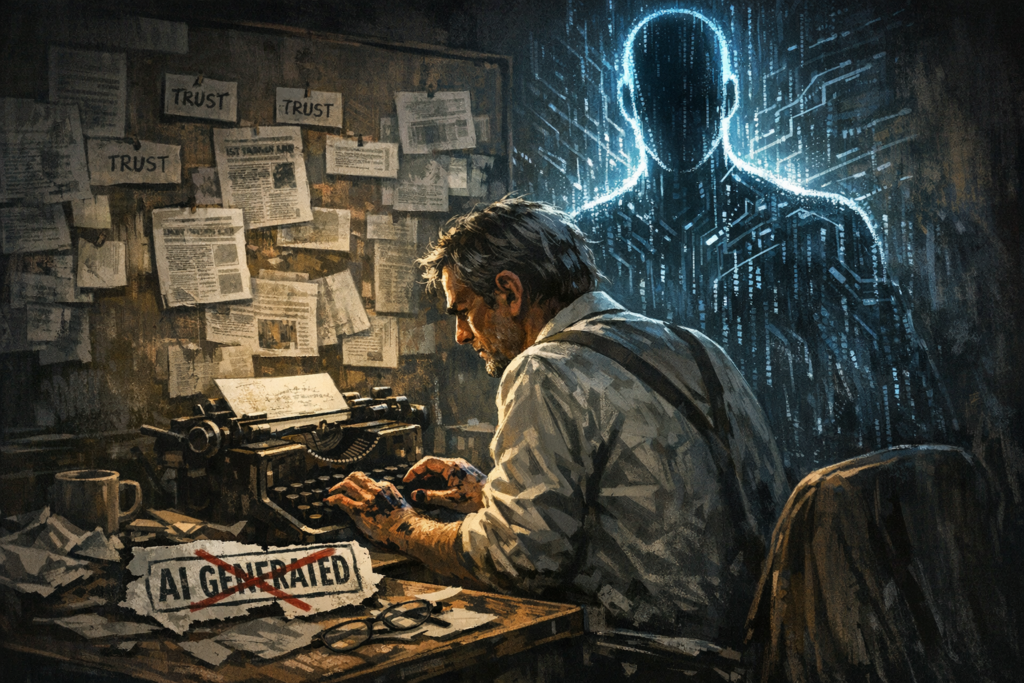

The recent experiment of drafting a novel in partnership with artificial intelligence has done more than test a new tool — it has exposed what writers actually bring to the table in an age when machines can spin sentences by the million. Far from proving authors expendable, the exercise highlights how the craft of writing—selection, revision, emotional calibration, voice, and cultural stewardship—remains stubbornly human. But it also shows how generative AI rewrites the rules of creation, distribution, and value in publishing.
When a machine supplies prose and the human supplies meaning
Modern large language models (LLMs) can produce fluent passages, mimic styles, and even extrapolate plot beats from a brief prompt. Yet producing text and producing literature are distinct activities. In the co-authored novel experiment, the AI provided drafts, ideas, and scaffolding; the human writer imposed coherence, moral stakes, pacing, and emotional truth. The result is not merely a text that reads well but one that resonates because a person made hard choices about what to include, what to cut, and what to leave ambiguous.
This division of labor — generative AI for volume and variation, humans for judgment and meaning — reframes value in the creative pipeline. The writer is now less the sole origin of words and more the director of creative intent, the arbiter who shapes raw output into a distinct cultural artifact.
From writing as labor to writing as curation
One predictable effect of AI-assisted novel-writing is a shift in the writer’s primary labor. Routine drafting can be delegated to models: scene scaffolds, character sketches, dialogue options, and alternative endings. But the critical work becomes curation: choosing among model outputs, refining voice, orchestrating arcs, and pruning content for cohesion and plausibility.
That curatorial role requires deep skills — sensitivity to subtext, control of tempo, knowledge of genre conventions, and the ability to sustain long-term narrative commitments. These are not tasks that scale well with automation because they depend on cumulative taste and judgement developed over time. Authors who internalize the AI toolset and treat models as creative collaborators will likely outperform both purely human writers and those who rely unquestioningly on model outputs.
Strategic context: who gains and who competes
Generative AI is catalyzing a new competitive landscape in publishing. Big tech companies provide powerful models and APIs; startups package them into specialized writing tools; self-published authors exploit them for rapid content generation. Traditional publishers face conflicting incentives: embrace the productivity gains and risk commoditization, or resist and risk obsolescence. Meanwhile, literary agents, editors, and screenwriters must reposition their services to emphasize judgment, taste, and rights management.
Three strategic dynamics deserve attention:
- Democratization vs. crowding: AI lowers the barrier to producing readable manuscripts, which can flood markets with content. That increases competition for reader attention and may depress returns for average titles, while boosting opportunities for niche and serialized formats.
- Tooling advantage: Authors and publishers that invest in proprietary model fine-tuning, retrieval-augmented generation, and internal editing pipelines will gain quality and efficiency advantages.
- Platform power: Retailers and subscription services that integrate AI-driven discovery and personalization could consolidate audience flows, shaping which authors and genres get visibility.
Risks that accompany faster prose
AI-assisted novels are not risk-free. Quality control becomes essential as models hallucinate details, flatten characterization, or reproduce biased or derivative material from their training data. At scale, the market may suffer from saturation with formulaic works that erode reader trust.
Legal and ethical questions amplify the risk profile. Authorship attribution, copyright for model-generated content, and the provenance of training data are unresolved. Writers, publishers, and rights holders may find themselves entangled in disputes over whether an AI’s output infringes on human-created content or whether datasets require compensation and consent. These are not only legal debates but will also shape public perception: works that transparently disclose AI involvement may fare differently in a marketplace that increasingly values authenticity.
Economic displacement and creative labor
Concerns about job displacement are real, though nuanced. Entry-level commercial writing roles — formulaic romance, basic marketing copy, or boilerplate genre fiction — are most exposed. Conversely, positions that rely on editing, voice cultivation, cultural savvy, and relationship-building are less susceptible. The likely near-term outcome is role reconfiguration: fewer workers producing initial drafts, more focused work on development, curation, and audience engagement.
Opportunities: new forms of storytelling and business models
Alongside the risks are fertile opportunities. AI can accelerate iterative experimentation, enabling writers to explore alternate timelines, test character arcs rapidly, or prototype multiple voice options. This can lead to bolder structural experiments and blended forms — interactive novels, personalized narratives, and serialized microfiction optimized for short attention spans.
From a business perspective, models enable:
- Rapid A/B testing of copy and story variations to learn what resonates with readers.
- Personalization engines that tailor narrative threads to reader preferences, potentially unlocking subscription models with higher lifetime value.
- Efficient adaptation pipelines for cross-media transforms — prose to script to game dialogue — reducing friction in IP exploitation.
Technology levers that will determine winners
Not all generative AI is equal. The next wave of competitive differentiation will come from technical choices:
- Fine-tuning with licensed corpora: Models trained on curated, licensed text will produce safer, higher-quality output and avoid legal exposure.
- Retrieval-augmented generation (RAG): Tying generation to explicit source documents improves factual grounding and allows authors to maintain provenance over research and references.
- Watermarking and provenance: Techniques to signal AI-generated content will be crucial for transparency and platform moderation.
- Interactive tooling: Seamless editor integrations, version control for generated drafts, and collaborative interfaces will make AI more useful for professional authors.
Regulatory pressure will shape incentives
Policy choices will matter. Governments and rights organizations can push for dataset transparency, compensation schemes for training data, and mandates for disclosure of AI involvement. Publishers and platforms may adopt voluntary standards — similar to content rating systems — to maintain trust. Those who anticipate and embed compliance will reduce friction and build reputational capital.
Three plausible futures
To make sense of trajectories, consider three scenarios that could play out over the next five to ten years:
- Augmentation and premium curation: AI tools become ubiquitous, but readers value curated, human-authored voices. Premium imprints market “human-edited” or “human-guided” work. Authors who combine AI speed with strong editorial taste thrive.
- Personalized narrative ecosystems: Platforms build individualized story engines. Readers subscribe to adaptive narratives that evolve based on their inputs. Authors become architects of branching systems rather than sole narrators.
- Commoditization and consolidation: Flooded by cheaply produced titles, attention consolidates to a few major platforms and brands. Midlist authors suffer, and smaller publishers struggle unless they differentiate through community, quality, or niche focus.
What this means for authors, publishers, and readers
For authors: learning the craft of AI collaboration is becoming as important as mastering grammar. Prompt engineering, model selection, and post-generation editing are new baseline skills. But deep advantages accrue to those who preserve and refine their unique voice, who curate rather than merely generate.
For publishers: adopting AI is not optional if competitiveness matters. The strategic question is how to integrate it: invest in proprietary datasets, develop ethical licensing frameworks, and retool editorial workflows to focus on higher-value judgment tasks.
For readers: expect a wider range of offerings — from high-volume, low-cost entertainment to meticulously crafted, human-centric literature. How readers respond will influence which business models stick.
Closing reflection
Writing a novel with AI is less a take-down of human authorship and more a stress test of what makes literature meaningful. Machines can weave sentences; people decide which stories matter. The emergent battleground in publishing will be the zone where machine speed meets human taste. Those who master both will reconfigure cultural production, not by eliminating the writer, but by amplifying the kinds of judgment and emotional honesty that only humans can deliver. As tools evolve, the enduring value of writers will be measured not by their ability to produce words quickly, but by their capacity to choose, refine, and steward narratives that help readers make sense of their world.