
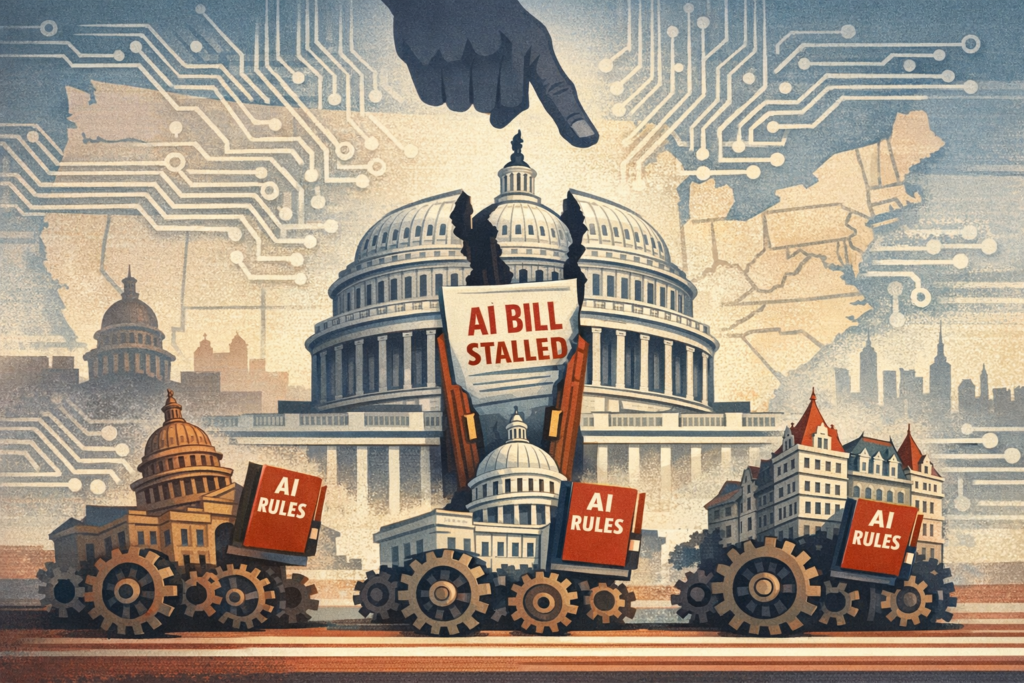
When political leaders push for rapid federal action on artificial intelligence while state capitals insist they are already moving faster, what emerges is not just a policy debate but a map of competing visions for how the U.S. should govern technology that can reshape economies, elections and national security. That tension—between a call for nationwide rules and the reality of a fragmented regulatory landscape—will determine whether America builds a coherent AI strategy or ends up with siloed experiments that frustrate businesses, researchers and the public.
Why an explicit federal push matters now
AI is no longer an arcane academic pursuit; it’s embedded in consumer apps, critical infrastructure and defense systems. That ubiquity multiplies risk. High-capacity models can produce realistic disinformation, automate cyberattacks, and accelerate biased decision-making at scale. At the same time, AI promises enormous productivity gains across manufacturing, health care and service industries. The tension between accelerating innovation and limiting harm is precisely why national policymakers are circling back to the issue.
A presidential-level appeal for congressional action signals several things. First, it recognizes that patchwork regulation leaves gaps attackers and bad actors can exploit. Second, it elevates AI as not only an economic issue but a strategic one: standard-setting at home affects global norms and competition. Finally, a federal law could simplify compliance for companies operating across multiple states and reduce legal uncertainty that chills investment.
Beyond fear and hype: what a federal role can realistically deliver
Expectations should be tempered. A national law can establish baseline duties—such as risk assessments for high-impact systems, disclosure requirements, and penalties for misuse—but it can’t micromanage every model architecture or product-level decision. Practical federal measures would likely focus on:
- Defining categories of risk and requiring stronger safeguards for high-risk uses (e.g., healthcare diagnostics, critical infrastructure controls, election systems).
- Mandating impact assessments, incident reporting, and auditing capabilities for large models and system providers.
- Setting transparency standards—what needs to be disclosed about model capabilities and limitations to downstream users.
- Coordinating export controls and national security-related restrictions on specific capabilities and compute resources.
These building blocks create portability across jurisdictions and provide the private sector with a clearer compliance roadmap. But they also require enforceable oversight, funding for technical regulators, and guardrails to protect innovation in research and startups.
The state-level response: laboratories of governance or regulatory noise?
States have reasons to act fast. Local officials deal with immediate consequences—local elections, schools, police departments and small businesses confronting AI deployments daily. This proximity encourages nimble policy experiments: digital ID rules, public procurement standards, algorithmic accountability in licensing decisions, and privacy protections tailored to state needs.
Where states lead, they often drive innovation in practice. A city or state that pilots algorithmic audit frameworks or mandates bias testing can generate operational knowledge on what works, providing models the federal government can later scale. These experiments can be particularly valuable in identifying enforcement pain points and realistic compliance timelines for smaller entities.
But multiple different standards present real costs. Companies face rising compliance burdens when each state defines its own disclosure, testing, or liability rules. Fragmentation can also create strategic arbitrage: companies might route services through permissive jurisdictions, undermining stricter local protections. The tension between experimentation and uniformity underpins much of the current policy debate.
Regulatory design: preemption, principles, and the risk of capture
One of the single most consequential choices Congress faces is whether federal legislation will preempt state laws. Preemption creates a national floor—and potentially shield companies from a thicket of local rules—but it risks undercutting state innovation and removing higher protections some states might prefer. The political calculus is complex: industry favors preemption for legal certainty, civil-society groups often view state-level rules as vital backstops.
Design choices also determine who enforces the rules. A centralized regulator with technical expertise could provide consistent oversight; alternatively, a distributed enforcement model relying on agencies like the Federal Trade Commission, the Department of Commerce, state attorneys general, and sectoral regulators could preserve flexibility but complicate coordination.
There’s also the danger of regulatory capture. If rule-making disproportionately reflects incumbent tech companies’ perspectives—whether through lobbying, revolving-door staffing, or narrow definitions of compliance—new rules may entrench market power and stifle competition. Thoughtful policy should include mechanisms to uplift startups and open-research communities, for example through exemptions, graduated compliance timelines, or public funding for safe model evaluation infrastructure.
Technology levers that policymakers are overlooking at their peril
Drafting good AI policy isn’t just legal work; it requires deep technical parity. Several technical levers deserve more attention than they typically receive in political debates:
- Model provenance and audit trails: Requirements for logging training data sources, model lineage, and fine-tuning history can enable accountability without exposing intellectual property—if implemented carefully.
- Independent red-team testing and third-party certification for high-risk models to validate safety claims.
- Standards for synthetic data and privacy-preserving training to reconcile model utility with data protection.
- Controls on compute and dataset exports to address proliferation of dual-use capabilities.
Allocating resources to build public infrastructure—secure labs for model testing, standardized datasets for audits, and accessible explainability tools—could lower the compliance cost for smaller actors and make enforcement feasible.
Business and market consequences: winners, losers, and strategic pivots
Regulation inevitably reshapes markets. Large cloud providers and integrated platform companies are positioned to absorb compliance costs and integrate safety features into product roadmaps; compliance can be a competitive moat for them. Conversely, startups, academic groups, and open-source modelers face tougher choices: heavy-handed rules could choke off experimentation and slow innovation, while lax rules risk public backlash and liability.
We’re likely to see several market responses:
- Strategic consolidation as midsize companies seek scale to manage regulatory burdens.
- A bifurcation between “compliant enterprise AI” for regulated sectors and “rapid innovation spaces” in less-regulated niches.
- Increased investment in AI assurance services—auditors, testing firms, and compliance tooling—as demand for third-party validation grows.
For investors, regulatory clarity is a double-edged sword: predictability reduces legal risk and unlocks capital, but stricter standards can elongate time-to-market and raise operational costs.
Possible futures: scenarios to watch
Three plausible trajectories encapsulate the trade-offs ahead:
1) Federal baseline with cooperative federalism
Congress establishes a national baseline—risk categories, disclosure rules, and enforcement mechanisms—while allowing states to implement stricter protections. This hybrid model encourages innovation at the state level but reduces harmful fragmentation. Success hinges on strong coordination bodies and clear preemption boundaries.
2) Minimal federal law, maximal state experimentation
If federal action is modest or delayed, states will proliferate a patchwork of laws. This can accelerate diverse policy experiments but create a compliance maze for firms and uneven protections for citizens across states. Litigation will likely follow, potentially landing key questions before the Supreme Court.
3) Robust federal regulation that centralizes standards
A sweeping federal statute could set comprehensive rules and preempt stronger state laws. While this promotes uniformity and eases interstate commerce, it risks entrenching incumbent advantages and may be slow to adapt to rapid technical change.
Global context: why U.S. policy choices ripple abroad
U.S. decisions will shape international norms. If the U.S. adopts a middle-ground approach emphasizing transparency and sectoral safeguards, it could align with democratic partners and influence standards in trade negotiations. Conversely, lax U.S. rules could fuel a race-to-the-bottom, while overly rigid rules could cede leadership to blocs that favor industrial policy over civil liberties. Export controls and cooperation on model governance will be especially consequential in relations with rival powers.
Where we go from here
The immediate debate is political, but the underlying challenge is technical and institutional. Effective AI governance will require lawmakers to understand how models are built and deployed; for industry to accept meaningful accountability; and for states and the federal government to coordinate rather than compete. Without that alignment, the U.S. risks either stifling innovation or failing to protect citizens from demonstrable harms.
Policy success will not look like a single silver-bullet law. It will be a mosaic: federal baselines, state experiments that inform improvement, public funding for testbeds and audits, and international collaboration on standards. The hard work—translating broad principles into enforceable, technically informed rules—starts now. The choices made in this moment will shape who controls AI’s benefits and who bears its risks for years to come.