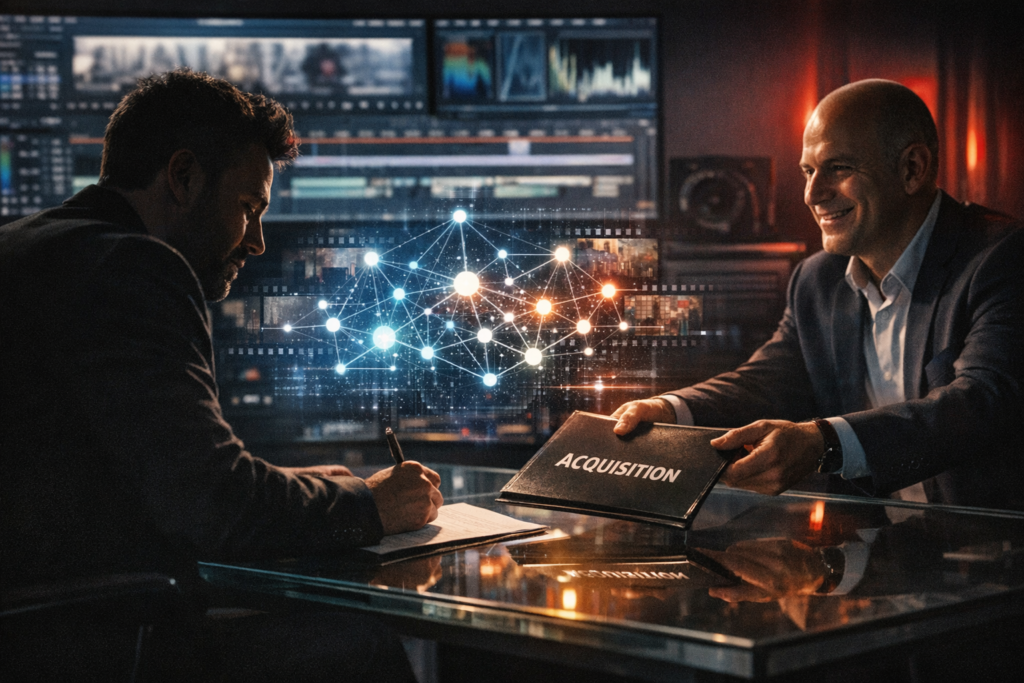
Netflix didn’t just buy a startup—it bought a faster path to making more content, more efficiently, with fewer postproduction bottlenecks. The acquisition of Ben Affleck-backed Interpositive, an AI postproduction company, is a signal that the next major battleground in streaming won’t be only about greenlighting hits. It will be about industrializing the pipeline: turning editing, localization, VFX coordination, and finishing into a scalable, software-driven system that can keep up with global demand.
This deal matters because generative AI is no longer confined to flashy demos or experimental writer tools. The highest ROI is emerging in the “unsexy” middle of the production stack—postproduction—where every day saved can translate into millions in working capital, tighter release schedules, and more agile content strategies.
What happened: Netflix acquires Interpositive
Ben Affleck has sold Interpositive, an AI-focused postproduction startup, to Netflix. The strategic rationale is straightforward: Netflix wants to bring more of the post pipeline in-house, accelerate turnaround times, and standardize tooling across its growing slate of originals. Interpositive has been positioned as a postproduction “operating layer” that applies machine learning to tasks such as media organization, footage analysis, versioning, and elements of editorial assistance.
From an industry analyst’s perspective, the most important takeaway isn’t celebrity involvement—it’s that Netflix is placing a bet on postproduction automation as a competitive advantage, likely integrating AI tools directly into its internal production and delivery workflows.
Why postproduction is the next AI goldmine
Most public discussion about AI in entertainment has centered on scripts, synthetic actors, or image/video generation. But in production economics, post is where complexity quietly compounds:
- Massive volumes of footage across multiple cameras, audio sources, and takes
- Multiple deliverables (different cuts, ratings versions, airline edits, recaps)
- Localization at scale (subtitles, dubbing, metadata, QC across languages)
- Compliance and QC (flashing, loudness, captions timing, legal clearances)
- Version control chaos across vendors, editors, VFX houses, and sound teams
AI excels when the problem is repetitive, rules-driven, or pattern-heavy—exactly the characteristics of many postproduction tasks. That’s why the acquisition reads less like a talent story and more like an infrastructure play.
What Interpositive likely brings to Netflix
While product specifics aren’t fully public, AI postproduction platforms generally focus on reducing time spent on coordination and technical glue work. Interpositive’s value to Netflix can be understood as four capabilities that streaming giants care about deeply:
1) Intelligent media understanding
Modern ML systems can index footage at scale: faces, dialogue, locations, objects, camera angles, and even emotional tone. That enables:
- Faster creation of selects and stringouts
- Better search (“find every take where the actor says X”)
- Automated logging and metadata enrichment
2) Workflow orchestration and versioning
Postproduction is often less about artistry and more about coordination. AI-enabled workflow tooling can track dependencies (picture lock → sound mix → QC → delivery) and reduce human time spent chasing files, naming conventions, and approvals.
3) Localization acceleration
For a global streamer, localization is a growth engine and a choke point. AI can support:
- Higher-quality subtitle timing through automatic alignment
- Draft translations for human review (human-in-the-loop machine translation)
- Voice workflows that speed casting, dubbing prep, and audio QC
4) QC and compliance automation
Automated quality control—detecting dropped frames, audio peaking, caption mismatches, or flashing patterns—can drastically cut QA cycles and reduce rework close to release dates.
Why Netflix is doing this now
The timing suggests Netflix is responding to three converging pressures:
- Content volume and cadence: More originals mean more post schedules overlapping. AI becomes a capacity multiplier.
- Margin discipline: Streaming economics increasingly require predictable spend and fewer overruns. Postproduction is a prime target for cost certainty.
- Global growth: International markets demand faster localization and culturally tailored deliverables—work that scales poorly without automation.
Owning AI postproduction capability is also a defensive move. If third-party AI vendors become critical infrastructure, they gain pricing power and influence. Netflix has historically preferred to control key parts of its pipeline when it creates strategic leverage.
Who benefits—and who feels threatened
Beneficiaries
- Netflix internal studios and production teams: Tighter integration, standardized workflows, fewer handoffs.
- Producers: Faster iteration cycles and earlier insight into schedule risk.
- Post supervisors and coordinators: Less administrative burden, better tracking, fewer “version confusion” errors.
- Localization teams: Enhanced throughput and the ability to support more languages with consistent QC.
Threatened stakeholders
- Traditional post vendors relying on manual processes: When a major buyer internalizes automation, pricing pressure spreads.
- Workflow SaaS vendors: If Netflix builds a proprietary stack, it may diminish the role of third-party tools in Netflix-led productions.
- Entry-level post roles: Logging, assistant editing support tasks, and certain QC functions may be partially automated—changing career pathways.
It’s crucial to separate task automation from job elimination. Many roles will evolve rather than disappear. But the economic center of gravity shifts toward people who can supervise AI systems, manage exceptions, and ensure creative intent survives the automation layer.
Market implications: the streaming arms race moves into the pipeline
This acquisition fits a broader pattern: the biggest media buyers are becoming software companies in their own right. The competitive frontier is no longer only “who can fund the best shows,” but:
- Who can ship faster without lowering quality
- Who can localize better and capture international demand
- Who can reduce post risk and avoid last-minute overruns
Expect rivals—Disney, Amazon, Apple, and major studios—to deepen partnerships with AI postproduction vendors or pursue acquisitions. The strategic logic mirrors what happened in ad tech and analytics: once tooling becomes performance-critical, the largest players either buy it or build it.
Real-world use cases: where AI postproduction delivers immediate ROI
To understand why Netflix paid to acquire rather than merely license, look at daily pain points AI can reduce:
- Automated dailies review support: Scene and take clustering; surfacing best takes based on script alignment and performance signals.
- Smart transcripts linked to timelines: Editors search dialogue and jump directly to moments in the NLE timeline.
- Continuity and asset tracking: Identifying recurring props/wardrobe and ensuring shot matching across episodes.
- Trailer and promo versioning: Faster creation of compliant variants for platforms, territories, and audience segments.
- Localization QA at scale: Checking subtitle constraints (reading speed, line length) and flagging mismatches between dubbed audio and captions.
None of these remove the need for editors, sound designers, or finishing artists. They remove the “glue work” that slows them down.
The hard parts: quality, rights, and trust
AI in postproduction isn’t plug-and-play. Netflix will need to manage several risks:
- Model reliability and bias: Scene detection, face recognition, and speech-to-text can fail unevenly across accents, languages, and lighting conditions.
- Security and leakage: Post assets are highly sensitive. AI tooling must meet studio-grade security standards, especially if any compute touches cloud services.
- Labor relations: AI deployment intersects with union concerns about credit, compensation, and work displacement. Clear governance and transparency matter.
- Creative integrity: Automation must support the edit, not steer it. Editors will resist tools that feel like “creative autopilot.”
The winners will be companies that treat AI as assistive infrastructure with human oversight—not as a replacement for craft.
Expert outlook: what happens next
Three predictions follow from this acquisition:
- AI-native post pipelines become standard within 24–36 months. Not everywhere, but at the top end of volume-driven producers—streamers, major studios, and mega-indies.
- Localization becomes the killer application. The biggest measurable gains will come from faster, more consistent multilingual delivery and QC—especially for series with rapid release cycles.
- New roles emerge: “AI post supervisors,” “localized QC analysts,” and “model governance leads” will become distinct job categories inside studios.
Strategically, Netflix is also building optionality. If its AI post stack becomes a genuine differentiator, it can use it to attract top producers with the promise of smoother operations—or simply to outpace competitors in release velocity.
FAQ
Is this mainly about generative AI creating scenes or altering performances?
No. The most immediate value in AI postproduction is workflow automation: indexing footage, accelerating search, managing versions, improving QC, and speeding localization—rather than generating new story content.
Will this reduce demand for editors and post professionals?
It’s more likely to reduce time spent on repetitive tasks (logging, basic QC checks, administrative coordination). High-skill creative and finishing work remains essential, but the skill mix will shift toward people who can supervise AI-assisted workflows.
Why would Netflix buy instead of partner?
Owning the technology can provide tighter integration, better security control, and long-term cost advantages. It also prevents dependency on third-party vendors for mission-critical pipeline capabilities.
What’s the biggest business impact for Netflix?
Speed and scalability: faster turnaround from shoot to release, lower post overruns, and more efficient localization—supporting both margin goals and global growth.
Conclusion
Ben Affleck’s sale of Interpositive to Netflix is a hallmark deal for the next phase of AI in media: less spectacle, more infrastructure. By bringing AI postproduction technology into its core operations, Netflix is effectively betting that the winners of the streaming era will be those who can industrialize creativity—not by replacing artists, but by removing friction from the pipeline that delivers their work to a worldwide audience.
If Netflix executes well, this acquisition won’t be remembered as a celebrity startup exit. It will be remembered as a turning point where AI became a quiet, indispensable layer in how premium content gets finished, localized, quality-checked, and shipped—at the speed global audiences now expect.