
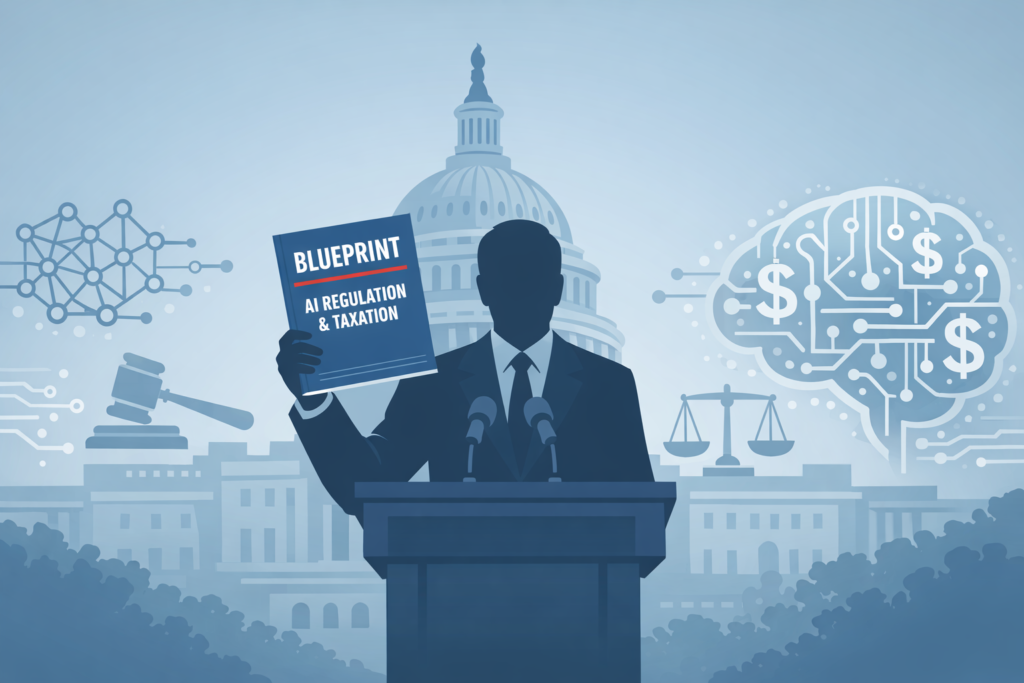
When a leading CEO of a company whose product has become shorthand for the hottest technological disruption calls for taxation and regulatory guardrails, the moment is worth pausing over. Sam Altman’s public push for a structured way to tax and regulate artificial intelligence is not merely an ethical posture — it’s an invitation to rethink how societies govern a technology that is both an engine of productivity and a potential source of concentrated power and disruption.
A different voice from inside the innovation engine
Tech executives often lobby against regulation. That makes Altman’s blueprint striking: a senior industry actor acknowledging externalities and proposing that the industry itself accept new rules and financial obligations. This is not a call to slow innovation for its own sake, but an attempt to align incentives — to make sure the gains of AI do not come at unchecked social cost.
At its heart, the proposal signals three intertwined themes that will shape AI governance debates in the coming years: measurable thresholds of capability, financial mechanisms to internalize social costs, and institutional oversight that can adapt to rapid technical change. Those themes map to concrete policy tools — licensing, levies tied to compute or revenue, and independent auditing regimes — each with trade-offs worth unpacking.
Why industry-backed regulation matters
When the companies building advanced AI systems endorse regulation, policy discussions gain legitimacy and technical realism. Industry insiders can articulate how models scale, how compute and data flow through cloud ecosystems, and where technical enforcement is feasible. Their participation increases the likelihood that rules will be implementable rather than symbolic. But industry-driven proposals also raise legitimate concerns about capture: the risk that regulations will entrench incumbent players and make it harder for startups or open-source projects to compete.
Taxation as a social contract
A central strand of the blueprint is the idea of an AI tax: a mechanism to capture a portion of the economic value generated by advanced AI and channel it into public goods. Framing a tax as redistribution is familiar — akin to levies on extractive industries or carbon taxes — but AI is a distinct case because its benefits are diffuse and the harms can be sudden and systemic.
Potential models for taxation include:
- Levies on compute or data center usage above a defined threshold, reflecting the correlation between compute intensity and model capability.
- Revenue-based taxes for companies earning from AI-driven products and services.
- Targeted contributions for specific risks, such as funds for displaced workers, AI safety research, or cybersecurity resilience.
Each approach has pros and cons. Compute-based levies are more closely tied to the resource inputs that drive capability, but they require cooperation from cloud providers and may push computation offshore. Revenue-based taxes are easier to administer but might penalize downstream applications that rely on modest AI components.
Regulation beyond checklists: capability-sensitive governance
Altman’s blueprint leans toward capability-sensitive governance — rules that scale with what models can do rather than their mere existence. This is a crucial departure from traditional tech regulation, which often categorizes by product type or sector. For AI, capability thresholds make more sense: a small classification model has negligible systemic risk; a model that can autonomously generate convincing disinformation, design biological agents, or evade safeguards has outsized externalities.
Operationalizing capability-based rules will require robust testing regimes and transparent benchmarks. That creates a new market for independent red-teaming, third-party audits, and standardized evaluation suites. Companies may be incentivized to certify models to access markets, similar to safety certifications in other industries.
The enforcement challenge
Policymakers will need to answer hard questions: who tests models, how frequently, what penalties apply for non-compliance, and how to deal with open-source or decentralized models? Enforcement may rely on a mix of legal authorities, international cooperation, and private-sector monitoring. Cloud platforms could play an outsized role, by flagging anomalous compute patterns or enforcing usage policies tied to model licenses.
Competitive dynamics: incumbents, startups, and open source
Regulatory and tax frameworks will reshape competitive dynamics. Two intuitive but competing outcomes deserve attention.
First, stringent licensing and compliance costs can advantage large firms that have the capital and legal infrastructure to absorb them. That might consolidate power within today’s incumbents — Microsoft, Google, Amazon, Meta — and raise barriers to entry for entrepreneurs and researchers.
Second, clearly articulated rules can level the playing field by creating predictable expectations. Smaller players can design compliance into their products from the start, and a regulated market may reduce the arbitrary advantage of secretive development. Moreover, explicit public funding — financed through an AI tax — could support open research, safety labs, and workforce training.
Open-source models complicate the picture. Decentralized development can outpace regulation; eveasion or fragmentation could make enforcement difficult. A practical policy mix might combine incentives for compliant distribution (e.g., certification stamps, preferential procurement) with targeted legal liabilities for misuse, while supporting accessible, safe open research pathways.
Technological consequences: design incentives and safety engineering
Regulation tied to capabilities and taxes tied to compute would change engineering incentives. Firms might prioritize efficiency — achieving capabilities with less compute — which could be socially beneficial in terms of energy use. Conversely, heavy penalties on compute could discourage necessary experimentation or push research underground.
One positive outcome may be a new emphasis on intrinsic safety: models designed with verifiable constraints, better interpretability, and built-in monitoring. Compliance regimes will reward architectures that provide logs, traceability, and behavior controls. This could accelerate investments in tools like model watermarking, rollback mechanisms, and robust adversarial testing frameworks.
Governance at scale: domestic policy and international coordination
AI is global in both talent and infrastructure. A unilateral tax or licensing regime will face leakage: compute, data, and talent can move across borders. Effective governance will require international coordination — not identical rules everywhere, but harmonized standards for high-risk capabilities and mechanisms for information sharing and enforcement assistance.
Historical analogies are imperfect: AI is unlike nuclear technology, which needs specialized facilities and materials. Yet there are lessons from aviation and pharmaceutical regulation where cross-border standards and certification play central roles. A pragmatic pathway involves national baseline rules complemented by mutual recognition agreements, cooperative research into safety standards, and export controls for clearly defined dual-use capabilities.
Scenarios to watch
- Fragmented Approach: Countries adopt varied rules; talent and compute migrate to lax jurisdictions, creating unequal technological landscapes and regulatory arbitrage.
- Incumbent Consolidation: Heavy compliance costs favor large players, reducing competition but possibly increasing centralized safety capacity.
- Coordinated Governance: Major economies agree on capability thresholds, mutual certification, and shared funding for safety R&D — creating a stable but adaptable global regime.
- Innovation-First Backlash: Overly punitive rules spur political resistance and rollback, slowing safety advances and elevating short-term risks.
Market opportunities and new institutions
If implemented thoughtfully, Altman’s proposals could catalyze new markets: firms offering AI audits, compliance-as-a-service, safety tooling, model insurance, and specialized training programs. Governments and multilateral institutions might establish public labs for certification and red-teaming, funded by levies on leading AI producers. Financial instruments may emerge to underwrite tail risks associated with advanced autonomy.
There’s also a reputational dimension. Companies that embed safety and pay into public goods can build trust with users and regulators — a scarce commodity in AI. This could become a competitive differentiator as consumers and enterprises demand verifiable safety guarantees.
Risks of implementation and perverse incentives
Policy design mistakes will have real costs. Poorly targeted taxes could dampen useful applications, drive offshoring, or spur evasive tactics like fragmenting models across jurisdictions. Overly rigid licensing could ossify standards and prevent adaptive responses to unexpected harms. Regulatory capture is a perennial risk: if incumbents shape rules, regulation can be weaponized against competition.
To mitigate these risks, rulemaking should be iterative, transparent, and include diverse stakeholders — technologists, civil society, labor groups, and international partners. Sunset clauses, periodic review, and pilot programs can help avoid lock-in while preserving stability for businesses.
Where this proposal could lead
The significance of an industry leader proposing taxation and licensing is not just the policies themselves, but the shift it signals: tech firms acknowledging civic obligations and the need for institutional structures to manage AI’s externalities. Whether that leads to a balanced, enforceable system or a balkanized mosaic of rules will depend on political will, technical feasibility, and the willingness of companies to cede some autonomy for collective stability.
We are at a policy inflection point. The choices made now — about how to measure capabilities, who enforces rules, and how to distribute the benefits of AI — will determine whether the technology amplifies opportunity broadly or consolidates power narrowly. The next few years will test whether governance can keep pace with capability, and whether industry, government, and civil society can turn a provocative proposal into robust, equitable institutions.