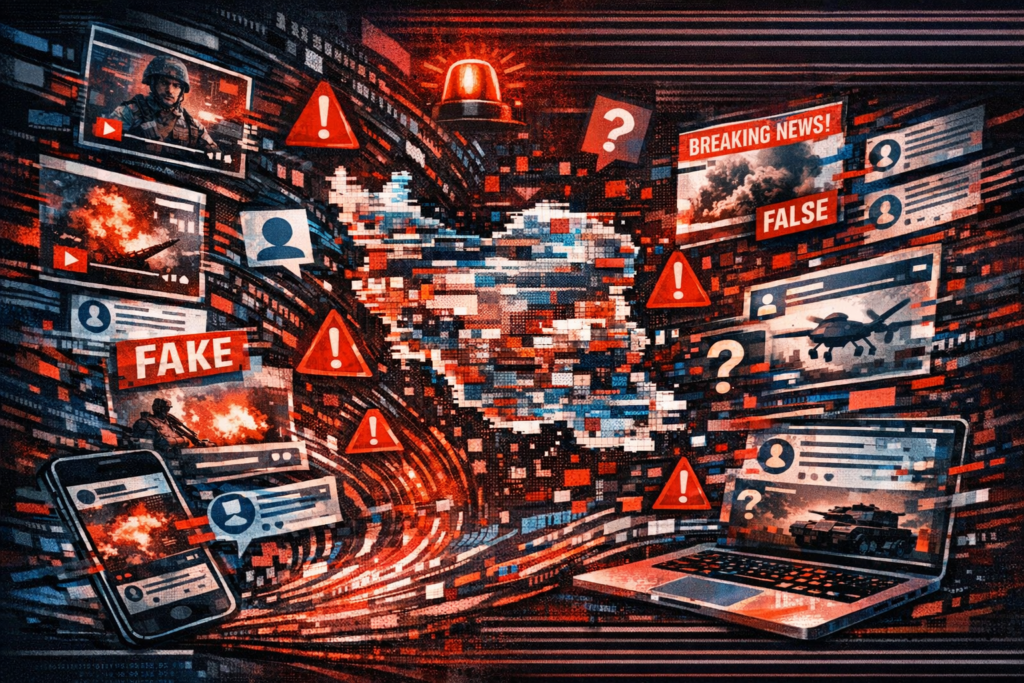
A wave of convincing AI-generated audio and video is accelerating a new front in information warfare, turning social feeds into contested territory where simulated leaders, fabricated battlefield footage, and orchestrated narratives can sway public opinion in minutes. The emergence of these deepfakes during the Iran conflict is not just a headline—it’s a critical inflection point for the AI industry, media companies, policymakers, and any organization that relies on digital trust.
What happened: a snapshot of the deepfake-driven chaos
Multiple highly realistic synthetic videos and audio clips purporting to show battlefield events and public statements tied to the Iran conflict have circulated across social platforms and messaging apps. Many of these assets used generative models to alter faces, synthesize speech, or splice together footage in ways that are difficult for casual observers—and even some automated filters—to detect. These manipulations have been amplified by coordinated sharing, creating a rapid cascade of misinformation that complicates fact-checking and inflames public sentiment.
How these deepfakes are built (brief technical view)
Modern deepfakes rely on a combination of techniques from the generative AI toolbox:
- Diffusion models and GANs for photorealistic image and frame generation.
- Neural voice cloning and TTS (text-to-speech) models to replicate speech patterns and intonations.
- Multimodal transformers to align lip movements with synthesized audio and to generate contextual visuals.
- Low-cost orchestration using public data and open-source toolkits, enabling non-experts to produce convincing forgeries.
Why this matters for the AI industry
The incident exposes several intersecting risks and responsibilities for AI companies:
- Trust erosion: When synthetic media can mislead at scale, public trust in digital content and platforms declines, threatening the fundamental value proposition of online information ecosystems.
- Regulatory scrutiny: Governments will accelerate calls for enforceable safeguards—both technical (watermarking, provenance) and legal (liability, disclosure mandates).
- Product differentiation: Safety and verification capabilities will become major competitive axes for AI platforms and cloud providers.
Who benefits
- Malicious actors and state-backed groups gain asymmetric influence with relatively low cost and effort; deepfakes act as force multipliers in psychological operations.
- Disinformation networks can weaponize synthetic media to harden narratives, discredit opponents, or trigger reactive behaviors.
- Security vendors and verification startups see increased demand for detection tools, provenance services, and content authentication platforms.
Who is threatened
- Journalists and fact-checkers are burdened by a higher verification cost and greater risk of reputational damage from inadvertently amplifying fakes.
- Platforms and publishers face trust and liability challenges; failure to detect or label deepfakes can lead to regulatory penalties and user attrition.
- Democratic institutions and civil society groups risk manipulation that undermines public debate and civic processes.
Market and business implications
The arrival of sophisticated synthetic media reshapes several markets:
- Cybersecurity and content authentication: Rapid growth in AI forensics, watermarking-as-a-service, and chain-of-custody platforms—investors will flock to startups offering reliable provenance and tamper-evidence.
- Cloud and compute providers: Demand for scalable GPUs and inference infrastructure will surge as both generative creators and detection systems require heavy compute.
- Adtech and brand safety: Advertisers will push platforms for stronger verification to avoid brand contamination from surrounding malicious or misleading content.
- Legal and compliance services: New offerings around content liability, incident response, and regulatory compliance will become standard for enterprise customers.
Practical business impact
Organizations should anticipate direct and indirect costs:
- Operational: Increased spend on moderation, forensic analysis, and rapid-response communications teams.
- Reputational: False associations from deepfakes can erode customer trust and require costly corrective campaigns.
- Insurance and liability: Cyber and reputational insurance will evolve to cover synthetic-media incidents, potentially raising premiums for high-risk sectors.
Real-world use cases: misuse and legitimate applications
Malicious use cases
- Synthesizing speeches to provoke panic, influence stock prices, or incite violence.
- Creating fabricated battlefield footage to mislead opponents or international observers.
- Impersonating officials to authorize false orders or financial transactions.
Legitimate and beneficial use cases
- Film and entertainment: Ethical, consent-driven face replacement and voice synthesis for creative production.
- Accessibility: Personalized synthetic voices for users who have lost their ability to speak.
- Training and simulations: Realistic mockups for emergency response training and educational content.
How to fight back: detection, policy, and platform measures
Combating synthetic media demands a layered approach combining technology, policy, and user education:
- Technical defenses: Robust detection models, provenance metadata, and cryptographic watermarking embedded at creation time.
- Platform governance: Faster takedown workflows, labeled content, and transparent reporting of manipulated assets.
- Regulatory measures: Standards for mandatory disclosure of generated content, and liability frameworks for recurrent offenders and enabling services.
- Public literacy: Targeted information campaigns to help users spot probable fakes and verify sources.
Future predictions and expert commentary
Looking ahead, expect the following trends to crystallize over the next 12–36 months:
- Ubiquitous provenance: Major platforms and content-creation tools will adopt signed metadata standards to prove origin, or risk losing advertiser and regulatory support.
- Arms race between creation and detection: Generative models will incorporate counter-detection techniques while detectors rely on ensemble approaches and behavioral signals beyond pixel-level artifacts.
- Commercial opportunity for verification: A new class of enterprise services—real-time verification APIs, forensic-as-a-service, and accredited authentication providers—will emerge as essential infrastructure.
- Legal codification: Expect clearer rules around disclosure, plus sanctions for those who intentionally engineer and distribute harmful synthetic media.
Expert viewpoint: Companies that integrate provenance, invest in human-in-the-loop moderation, and partner with reputable verification firms will be best positioned to maintain user trust. Market leaders will treat safety features as product differentiators, not compliance burdens.
Practical recommendations for organizations
- Implement signed content workflows for internal and external media to create verifiable chains of custody.
- Deploy detection toolkits and connect them to incident response plans for rapid mitigation.
- Train spokespersons and communications teams to respond quickly and transparently to deepfake-driven rumors.
- Engage with standards bodies and cross-industry coalitions to push interoperable provenance protocols.
FAQ
Q: How can I tell if a video or audio clip is a deepfake?
A: Look for contextual inconsistencies (timing, background details), anomalies around lip-sync or eye movement, unusual voice cadence, and source provenance. Use reputable verification tools and reverse-image/video search. When in doubt, treat viral clips with caution until independently corroborated.
Q: Are current AI models capable of reliably detecting deepfakes?
A: Detection models can flag many manipulations but aren’t foolproof. The technology is in constant flux—both attackers and defenders iterate quickly. Best practice combines automated detection with human review and metadata verification.
Q: Will regulation stop deepfakes?
A: Regulation can raise barriers and create accountability, but it won’t eliminate bad actors. Effective mitigation combines legal frameworks, platform enforcement, and technical provenance systems to raise the cost of misuse.
Q: What immediate steps should platforms take?
A: Adopt content provenance standards, accelerate labeling of synthetic media, bolster moderation capacity, and partner with independent fact-checkers and forensic vendors for rapid verification.
Conclusion
The rise of sophisticated deepfakes around the Iran conflict is a wake-up call: synthetic media has graduated from novelty to a strategic instrument for influence. For the AI industry, platforms, and businesses, the path forward requires integrating verification into product design, scaling forensic capacity, and advocating interoperable provenance standards. Those who invest early in trustworthy content infrastructure will protect users, preserve reputations, and unlock new market opportunities—while failure to adapt will invite regulatory penalties, brand damage, and a fractured information environment. Combating synthetic misinformation is no longer optional; it’s essential to sustaining digital trust.