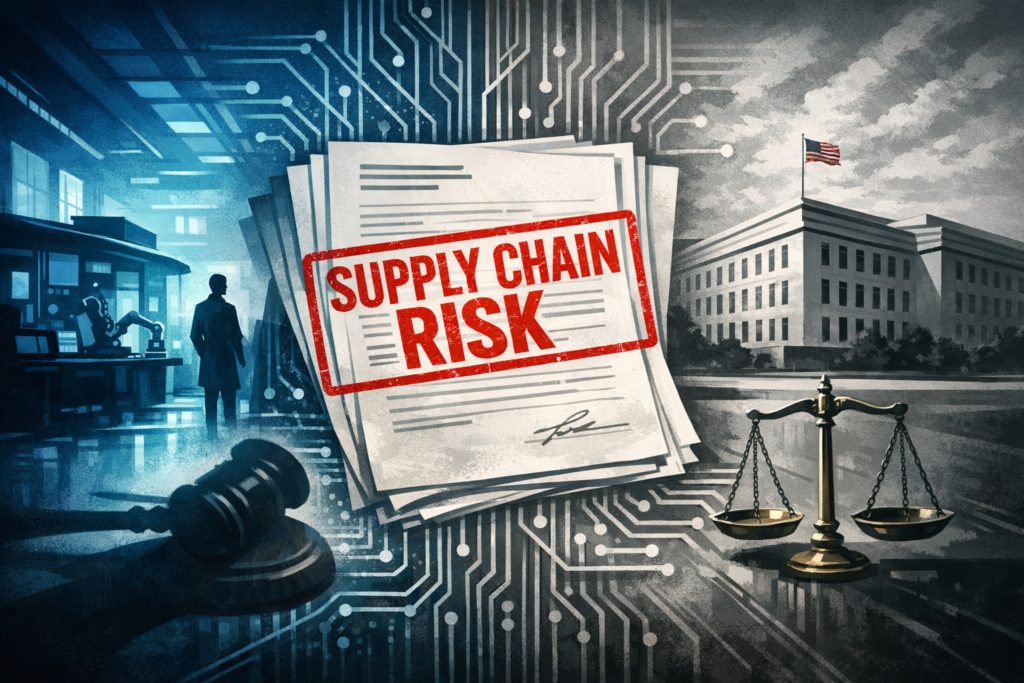
The legal fight between Anthropic and the U.S. Department of Defense over a “supply chain risk” designation is more than a courtroom skirmish — it is a signal flare for the AI industry. At stake are how governments police emerging AI suppliers, who gets access to lucrative public-sector contracts, and what standards will govern trust, transparency and national-security scrutiny for advanced machine learning providers.
Why this lawsuit matters
The dispute pits a high-profile AI company against a major national security buyer. If government agencies can unilaterally label AI vendors as supply chain risks — and thereby restrict or bar them from federal work — the decision sets a precedent that will reshape procurement, investment, and product strategy across the AI ecosystem.
- Procurement leverage: Government customers control significant contracting power. A designation that limits access to public-sector revenue can materially alter a startup’s growth trajectory.
- Reputational impact: Being publicly labeled a risk can deter commercial customers, partners, and investors even when the underlying concerns are opaque.
- Regulatory precedent: This case could define legal limits on how agencies apply national-security reviews to software and AI models.
What happened — clear and concise
Anthropic has challenged a Department of Defense determination that categorized the company — or certain of its services — as a supply chain risk. The company’s legal action contests the government’s authority or the process by which the designation was made, arguing the classification harms Anthropic’s business and that the government’s decision-making lacks sufficient basis or due process. The case raises fundamental questions about transparency, standards, and agency power in regulating AI suppliers.
Deeper analysis: why this matters for the AI industry
AI firms now occupy a dual role: commercial technology providers and strategic assets. Federal buyers — especially departments focused on defense and intelligence — have legitimate security concerns about where models are developed, how data is handled, and whether external dependencies create vulnerabilities. But indefinite or opaque exclusionary measures can also undermine innovation.
Regulatory tug-of-war: national security vs. innovation
Governments will increasingly demand assurances around:
- Data provenance — where training data originated and how it was curated.
- Model integrity — whether models have backdoors, undisclosed third‑party components, or hidden dependencies.
- Operational sovereignty — whether operations can be audited and run on trusted domestic infrastructure.
Companies that cannot demonstrate robust controls will face exclusion — but overly broad or secretive classifications risk chilling private-sector innovation and cross-border collaboration.
Operational and market implications
A few likely industry effects:
- Acceleration of onshore infrastructure: Providers may invest in sovereign cloud regions, isolated model deployments, and air-gapped environments to meet buyers’ security demands.
- Compliance as a competitive advantage: Vendors that design for auditability, explainability, and supply-chain transparency will win public-sector deals and attract security-conscious enterprises.
- Consolidation pressure: Smaller startups with international investors or opaque supply chains could become acquisition targets for larger firms that can absorb compliance costs.
Who benefits — and who is threatened
Beneficiaries
- Large cloud providers (those with sovereign regions and established government contracts) — they can offer compliant enclaves and take on security responsibilities.
- Security-focused AI vendors — companies explicitly marketing “trusted,” auditable, or on-premises model deployments.
- Defense and government contractors — they gain clearer leverage and potentially safer supply chains for sensitive applications.
Those at risk
- AI startups with global ownership or third-party dependencies — they may be disfavored for federal work and face investor uncertainty.
- Open-source projects — while valuable for innovation, they present provenance challenges and can be harder to certify.
- Firms relying on cross-border compute and data flows — restrictions may force major architectural changes or loss of market access.
Real-world use cases affected
Government and enterprise use of AI extends across many scenarios that are sensitive to supply-chain assurance:
- Intelligence and analytics: LLMs assisting analysts with summarization, trend detection, and cross-document correlation require confidence in data handling and model behavior.
- Logistics and maintenance: Predictive systems used in military logistics or critical infrastructure need resilient, auditable pipelines.
- Training and simulation: Synthetic data and model-generated scenarios used for training must be free from manipulative biases or corrupted inputs.
- Operational automation: Tools that automate administrative or mission-planning workflows must adhere to strict access and provenance controls.
Market implications and business impact
The litigation is a wake-up call for AI vendors and buyers alike. Practical effects include:
- Contract risk pricing: Startups may demand higher prices or contractual protections when engaging with government buyers to offset compliance burdens.
- Investor scrutiny: Due diligence will expand to include supply‑chain risk assessments, foreign investment background checks, and audit-readiness.
- Product roadmaps reorientation: Expect engineering roadmaps to allocate more resources toward explainability, provenance tracking, and deterministic deployment options.
Future predictions and expert commentary
Several plausible trajectories follow:
- Legal clarifications will emerge: Courts could define the limits of agency power to label vendors, prompting clearer administrative procedures and appeal mechanisms.
- Standards and certifications will appear: Industry-driven trust frameworks — akin to SOC/ISO for cloud services — will likely develop for AI model provenance and supply-chain integrity.
- Geopolitical segmentation of AI infrastructure: Expect more “sovereign AI” initiatives where governments sponsor local compute and model ecosystems to reduce dependence on foreign providers.
- Commercial differentiation: Firms that can prove secure, auditable models will capture growth in regulated markets (defense, healthcare, finance).
From an expert perspective: this lawsuit is not merely a company defending revenue — it’s a crucible moment for how society governs advanced AI. The outcome will influence vendor behavior, investment flows, and the architecture of trustworthy AI systems.
Short FAQ
Q: What does a “supply chain risk” designation mean for an AI company?
A: It generally signals that a government buyer considers elements of the vendor’s technology, ownership, or dependencies to pose security or reliability concerns. Practically, it can restrict the company from certain contracts and damage commercial reputation.
Q: Can a government freely exclude vendors for national-security reasons?
A: Governments have broad authority to protect national security, but exclusions are constrained by administrative law, procurement rules, and sometimes judicial review. Legal challenges can force agencies to justify their processes and evidence.
Q: How should AI vendors prepare for increased supply-chain scrutiny?
A: Invest in transparency: document data sources, dependencies, and third-party components; implement auditable model development pipelines; offer on-premises or sovereign-region deployments; and secure independent certifications where possible.
Q: Will this slow down AI adoption by governments?
A: Possibly in the short term. However, it will also incentivize secure architectures and trusted suppliers, which could accelerate adoption once standards and compliance paths are clear.
Q: How could this affect private-sector customers?
A: Enterprises with security needs will likely mirror government standards, increasing demand for compliant AI offerings and raising the bar for vendors across regulated industries.
Conclusion
The dispute between Anthropic and the Department of Defense highlights a defining tension of the AI era: balancing rapid technological progress with legitimate security controls. The case will shape how governments define and enforce supply-chain risk for AI providers, influence which companies can access public-sector markets, and accelerate the creation of technical and legal infrastructures for trustworthy AI.
For AI companies, the message is clear: transparency, auditability, and sovereign deployment options are no longer optional. For governments, the challenge is to craft rules that protect security without needlessly constraining innovation. The outcome of this lawsuit will reverberate across procurement desks, boardrooms and cloud regions — and it will inform how trust is built into the next generation of AI systems.