
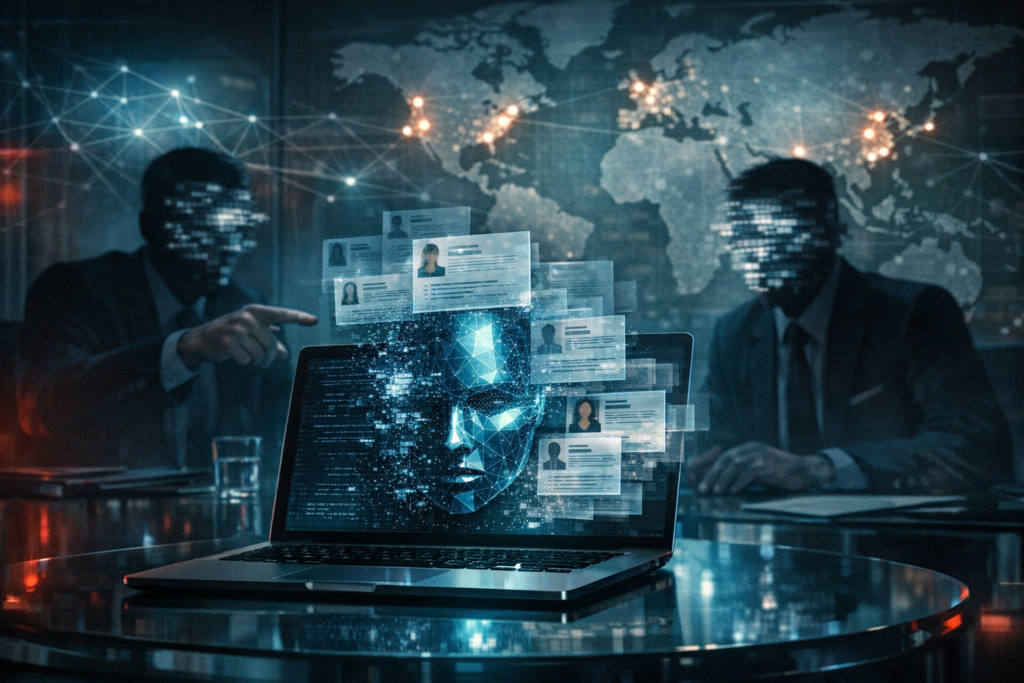
Imagine a job candidate who never existed, passes automated screening, delivers a convincing video interview, and walks out of onboarding with valid corporate credentials — all created and orchestrated by an adversarial actor using generative AI. That scenario is no longer hypothetical. Microsoft has publicly warned that North Korean agents are leveraging AI-generated personas and other tools to infiltrate Western firms through the hiring process. This development turns recruitment — traditionally a low-risk business function — into a new frontline in the cybersecurity arms race.
What happened and why it matters
Microsoft reported evidence of a campaign in which threat actors used advanced AI capabilities to fabricate credible identities, fake employment histories, and otherwise bypass corporate onboarding and vetting processes. These campaigns combine synthetic identity creation, deepfake media, AI-assisted writing and coding, and automation to scale deception across hiring channels like LinkedIn, job portals and applicant tracking systems.
Why this matters: hiring is an access vector. Once an adversary succeeds in becoming an employee or contractor — even at a low privilege level — they gain proximity to systems, data, and insiders that can be exploited, amplified or sold. The use of generative AI turns social engineering from an artisanal operation into a systematic, scalable threat.
How the campaign appears to work
- Synthetic personas: Creation of plausible profiles with consistent resumes, endorsements, and social footprints that pass initial checks.
- AI-enhanced interviews: Use of deepfake video or AI-generated voice and text to perform live or asynchronous interviews convincingly.
- Automated candidate generation: Scaling hundreds or thousands of applications using generative models to tailor submissions and circumvent keyword-based filters.
- Credential and code fabrication: Producing believable code samples, certifications or portfolios using AI-assisted development tools to satisfy technical screens.
- Operational tradecraft: Combining traditional supply chain and insider threat tactics with AI to maintain persistence and evade detection.
Deeper analysis: what this means for the AI industry
This incident is a wake-up call across several dimensions of the AI ecosystem.
Trust and provenance become strategic requirements
Generative AI excels at producing realistic artifacts: text, images, audio, video and even code. The VOICE of authenticity — the metadata, origin, and chain of creation — will be just as important as model capabilities. AI vendors, identity verification firms, hiring platforms and enterprises must invest in provenance signals, watermarking and model attestations so that artifacts can be validated end-to-end.
HR tech and recruitment platforms are exposed
Applicant tracking systems (ATS), job boards and professional networks were built for human workflows, not adversarial automation. Expect vendors to embed anti-abuse features, AI-detection layers, and tighter integrations with identity verification services. This is an opportunity for startups and incumbents focused on secure hiring.
AI abuse catalyzes regulation and compliance pressures
Regulators will notice when hostile state actors weaponize AI to bypass sanctions and infiltrate companies. Compliance regimes around background checks, export controls and national security vetting are likely to tighten, increasing friction for global hiring and contractor sourcing.
Who benefits and who is threatened
Beneficiaries
- Adversaries: State actors and organized criminal groups gain scalable methods to recruit insiders and perpetrators.
- Security vendors: Identity verification, behavioral analytics, applicant screening and AI-forensics businesses will see growth.
- Compliance and consulting firms: Organizations needing help redesigning hiring processes will turn to external advisors.
At risk
- Enterprises: Particularly those with remote hiring models, high-value IP, or weak segmentation face data loss and sabotage.
- Recruitment platforms: Brand trust is at stake if their systems facilitate adversarial infiltration.
- Employees and customers: Insider access can lead to privacy breaches and downstream customer harm.
Market implications and business impact
The business consequences span immediate operational risk and longer-term market shifts.
- Rising demand for identity verification and background checks: Firms will pay more for multi-factor, multi-source identity proofs including biometric liveness checks, credential provenance and database corroboration.
- New segment growth: Expect investment in AI-detection, media provenance tools, and HR-security integrations. Insurtech and cyber insurance pricing will adjust to account for recruitment-based exposure.
- Zero trust and access reengineering: Companies will tighten onboarding policies — shorter windows for elevated access, staged permissions, enhanced monitoring, and stronger privileged access management.
- Talent sourcing frictions: Cross-border recruitment may face higher scrutiny, increasing costs and time-to-hire for global teams.
Real-world use cases and threat scenarios
Below are concrete examples of how a seemingly successful fake hire could be exploited.
1. Codebase sabotage or backdoor insertion
An infiltrator joins as a contractor to a software team and introduces subtle, persistent vulnerabilities or backdoors into code. AI-assisted code generation can help them produce code that appears legitimate and passes superficial reviews.
2. Data exfiltration via legitimate channels
An ostensibly low-privilege employee gathers and exports sensitive documents over time. Blending in with normal data flows, AI can automate exfiltration tactics and craft messages to avoid detection by DLP systems.
3. Privilege escalation through social engineering
Using an AI-crafted persona, the infiltrator builds relationships internally, manipulates helpdesk processes, and obtains credential resets or access approvals.
4. Intellectual property and sanctions circumvention
Access to proprietary designs, research, or supply chain contacts enables the adversary to accelerate domestic programs or help bypass sanctions by providing technical know-how.
Mitigation strategies and defensive playbook
Organizations must assume adversaries will use sophisticated AI and redesign hiring and onboarding accordingly.
- Strengthen identity proofing: Combine document verification, biometrics, live video checks and third-party corroboration.
- Adopt staged access: Limit privileges during probation; require multiple sign-offs for elevated permissions.
- Behavioral analytics: Monitor for anomalous patterns in code commits, data access, and communications.
- Technical controls: Enforce strong segmentation, least privilege, and rapid deprovisioning processes.
- Cross-functional vetting: Involve security, HR and legal teams in hiring for sensitive roles.
- Supplier and contractor scrutiny: Apply the same checks to third-party contractors as to direct hires.
Future predictions
- Acceleration of AI-for-good and AI-for-detection: Vendors will pivot to build models that detect synthetic content, provide provenance tagging, and verify human interactions.
- Industry standards for hiring authenticity: Expect consortiums or standards bodies to define minimum identity verification standards for certain roles.
- Regulatory push: Governments will mandate stricter vetting for hires in critical infrastructure, defense, and companies handling sensitive data.
- Adversarial escalation: As defenses improve, threat actors will refine techniques — for instance, combining real individuals’ information with synthetic overlays to create hybrid identities.
Expert commentary
From an industry standpoint, this is a pivotal moment. The fusion of generative AI and social engineering turns hiring into a potential attack surface on par with phishing and supply chain compromises. Businesses must treat recruitment risk as part of their cyber risk profile. Solutions will require coordination between HR, security, vendors and regulators — not just a single technical patch. Investing early in identity provenance, cross-cutting governance and behavioral monitoring will be a decisive competitive advantage.
FAQ
Q: How can companies tell if an applicant is AI-generated?
A: No single signal is definitive. Use layered verification: cross-check public records, validate documents with liveness checks, review behavioral history across platforms, and use forensic tools to detect synthetic media or anomalies in communication patterns.
Q: Are deepfakes the main risk here?
A: Deepfakes are one component. The larger threat is a composite of synthetic identities, AI-generated artifacts (resumes, code), and automated scaling that lets adversaries mount many attempts quickly. Detection must be holistic.
Q: Should companies stop hiring remotely?
A: Remote hiring is valuable and here to stay. The smarter approach is to harden processes — staged access, stronger identity proofs, and rigorous monitoring — rather than abandoning remote models altogether.
Q: What short-term steps should HR and security teams take?
A: Immediately review onboarding policies for sensitive roles, add multi-source identity checks, enforce probationary access limits, and create a joint HR-security incident response playbook for suspected fake hires.
Q: Will technology eventually solve this problem?
A: Technology can reduce risk but not eliminate it. Expect an ongoing cat-and-mouse dynamic where detection, verification, and policy evolve in response to adversary innovation. Human judgment, cross-organizational processes, and governance will remain critical.
Conclusion
The use of AI by state actors to penetrate Western firms via hiring transforms recruitment from an HR concern into a national security and cybersecurity issue. This isn’t solely a technical problem; it is organizational and strategic. Firms that proactively integrate identity provenance, rigorous vetting, zero-trust onboarding, and behavioral analytics will be best positioned to defend against this new vector. The race is on — and the winners will be those who can blend AI-driven defenses, human oversight, and robust governance into their talent strategies.