Introduction — When Speed Outruns Sanity
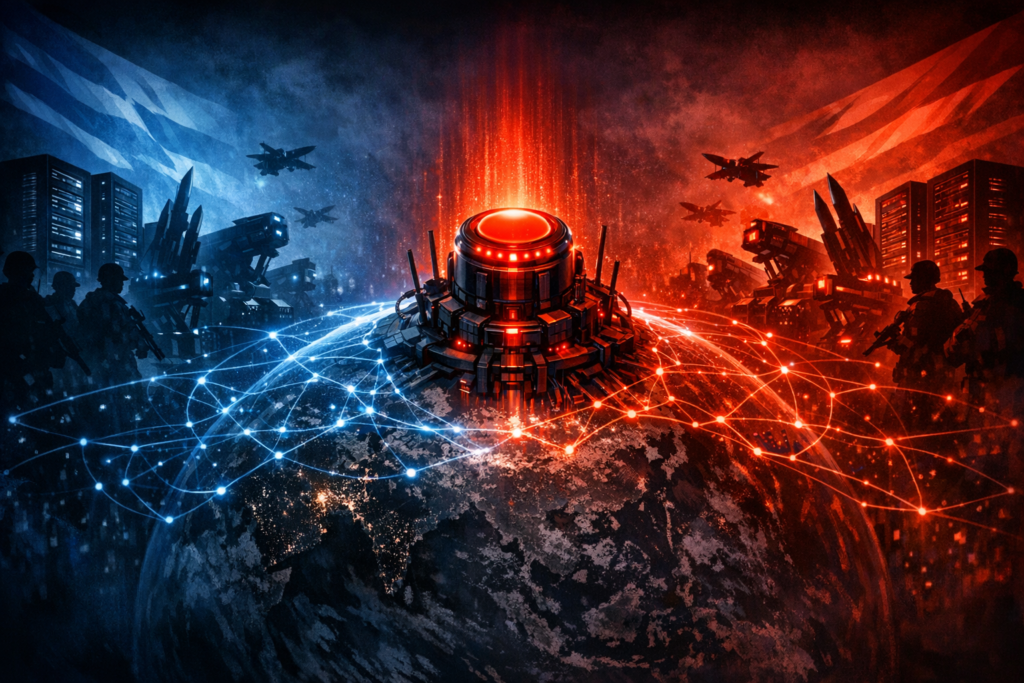
The Cold War’s doctrine of mutually assured destruction depended on human calculations, long reaction windows and an uneasy but understandable restraint: nuclear weapons were so catastrophic that leaders avoided using them. Today’s strategic environment is evolving into something stranger and faster — an AI arms race where machine-speed decision loops, autonomous cyberweapons and opaque algorithms can produce rapid escalation that no one planned for. Call it mutually automated destruction: a future in which automated systems on both sides trigger each other in cascading incidents that spiral into major conflict, infrastructure collapse or economic shock before a human can meaningfully intervene.
This is not science fiction. Nations are already embedding AI into command-and-control, cyber operations and kinetic systems. The combination of speed, opacity, and the dual-use nature of machine learning creates an instability different from classic arms competitions. The strategic question now is how to prevent automation from weaponizing uncertainty — and whether there is any realistic path to preserving stability while reaping AI’s benefits.
Machines between the buttons: how automation changes the calculus
Historically, escalation risk depended on intent and capability. AI changes both variables. Automated detection-and-response tools compress time between sensing and action. Autonomous cyber tools can launch offensive measures, patch or weaponize exploits, and coordinate attacks across domains (energy grids, financial systems, communications). Autonomous drones and lethally autonomous weapons can make real-time targeting decisions. Meanwhile, AI-driven misinformation and influence operations can alter political signals that once offered clear warnings.
Key shifts to appreciate:
– Speed: Algorithms operate orders of magnitude faster than human cognition, turning minutes into microseconds.
– Opacity: Modern ML models are often black boxes; their failures are non-intuitive and hard to predict.
– Scale: AI lowers the marginal cost to conduct complex operations, enabling rapid, distributed attacks.
– Attribution uncertainty: Automated attacks routed through cloud infrastructure and proxies exacerbate difficulties in identifying perpetrators.
Together these shifts create “auto-escalation loops.” A state deploys automated defensive or offensive systems. An adversary probes; the system fires back. The other side’s algorithms interpret that response as an attack and escalate. Each loop increases the probability of an uncontrolled cascade.
Who’s driving the race — and why incentives misalign
The AI arms race includes governments, militaries, private defense contractors, major cloud providers and well-resourced non-state actors. Their incentives differ, but the market pressures converge:
– States want strategic advantage, deterrence, and plausible deniability.
– Military organizations seek systems that reduce human risk and reaction time.
– Defense suppliers compete for lucrative contracts tied to performance metrics.
– Cloud and chip vendors race to capture compute demand and talent.
– Non-state actors exploit readily available models and tooling to punch above their weight.
This creates a classic tragedy of the commons. Short-term competitive advantages — faster models, more automation, fewer human checks — aggregate into systemic risk. Firms might trim safety processes to win bids; states might prioritize deployment over robust testing if it promises tactical superiority. The result is a collective downward pressure on safety standards.
Unique aspects compared to nuclear-era arms races
If nuclear proliferation taught the world anything, it’s that existential weapons change deterrence dynamics. But AI is different in critical ways:
– Lower barrier to entry: Powerful models and cloud compute are accessible to more actors than nuclear technology.
– Reversibility: Actions can be rapidly muted or restored (patches, rollbacks), which perversely encourages preemption and experimentation.
– Multiplicity of domains: Cyber, economic, social and kinetic channels can be hit simultaneously.
– Ambiguity: The line between civilian and military AI is blurred; the same algorithms drive logistics and offense.
These differences mean traditional arms-control paradigms (stockpile limits, inspections) are necessary but insufficient.
How an automated spiral might look — plausible scenarios
Consider a few stress-test scenarios that are technically plausible in the near term:
– Automated attribution error: An intelligence system flags anomalous traffic as state-sponsored intrusion. Automated defensive cybermeasures throttle or retaliate against assets later found to be legitimate third-party services. The other state’s automated defenses interpret the throttling as sanctioned aggression and launch a counterattack, triggering cascading outages across financial clearinghouses.
– AI-enhanced false flag: An adversary uses generative models and deep fakes to fabricate a battlefield incident that convinces automated monitoring systems an attack has occurred. Autonomous strike systems respond to the fabricated evidence before humans can verify.
– Rapid exploit chaining: A zero-day discovered in widely used industrial control software is weaponized by an automated toolkit that self-propagates. Nations deploy automated patching and isolation scripts which inadvertently trigger safety interlocks in power plants, creating blackouts and public panic. The political pressure leads to hasty kinetic responses.
– Market-plumbing collapse: High-frequency trading algorithms, augmented with AI, interpret anomalous signals as market stress and sell en masse. Other AI-driven risk systems detect liquidity closures and automatically withdraw, amplifying a flash crash that triggers national security review processes and emergency controls.
Each scenario shares a common thread: automation removes human friction that previously dampened escalation.
Technology and business consequences: winners, losers, and fragile infrastructures
The commercial dynamics are stark. Cloud providers, chipmakers and major AI vendors benefit from heightened defense spending and demand for hardened, explainable AI. But they also inherit systemic liability and reputational risk. Countries that capture the high-performance compute fabric could gain disproportionate leverage, encouraging export controls and nationalization of infrastructure.
For smaller firms, the landscape bifurcates: those that can certify safety and robust governance will find premium markets (defense, critical infrastructure), while others may be squeezed out or incentivized to cut corners. Insurance markets will respond — expect skyrocketing premiums for systems exposed to state-level adversarial risk and the emergence of new clauses around algorithmic oversight.
Operationally, critical infrastructure becomes a mosaic of interdependent AI agents — HVAC controls, grid management, traffic and logistics systems. Their coupling increases systemic fragility: an incident in one sector can cascade into unrelated ones.
Policy levers that could reduce systemic volatility
No single policy will solve mutually automated destruction. A portfolio approach is required:
– International norms and red lines: States should negotiate limits on autonomous offensive cyberweapons, similar to bans on indiscriminate weaponry, and agree that certain classes of systems (e.g., autonomous lethal targeting without human authorization) are unacceptable.
– Technical transparency: Standards for explainability, logging and forensically usable telemetry can make automated decisions auditable. Shared protocols for reporting incidents reduce attribution ambiguity.
– Human-on-the-loop requirements: Mandating human oversight for escalation-critical decisions introduces deliberate slack into high-speed loops.
– Defensive collaboration: A multinational rapid attribution consortium, funded and staffed jointly, could provide authoritative forensic assessments during contested incidents.
– Certification and liability: Independent auditing and certification for AI systems used in national infrastructure, backed by liability rules, would shift incentives toward safer design.
– Export and compute controls balanced with innovation: Targeted controls on offensive tooling and dual-use model capabilities, coupled with support for benign research, can manage proliferation without choking positive development.
None of these are easy. Verification is technically challenging and politically sensitive. But lack of governance creates a high-probability pathway to unintended conflict.
Industry actions that preserve competitive edge without sacrificing safety
Private firms are not helpless; several practical steps can reduce systemic risk without ceding strategic advantage:
– Build “de-escalation modes” into products — explicit operational states where autonomous responses require elevated human confirmation or are throttled under high-uncertainty conditions.
– Invest in adversarial robustness and explainability as market differentiators. Clients will pay for demonstrable resilience.
– Participate in pre-competitive standards consortia that define telemetry and incident-sharing mechanisms.
– Design with compartmentalization: limit cross-domain actions of AI systems so a failure in one sector can’t automatically trigger responses in another.
– Accept phased rollouts for automated capabilities with public red-team exercises involving independent third parties.
These moves are both prudent risk management and potential commercial differentiators.
Paths forward and possible outcomes
We face several plausible trajectories over the next decade:
– Managed stabilization: International norms, combined with private-sector safeguards and human-on-the-loop constraints, prevent widespread autoescalation while allowing defensive automation to improve resilience.
– Fragmented containment: Regional blocs impose divergent controls — some states push aggressive automation while others practice restraint, increasing localized risk and creating geopolitical rifts over compute and talent.
– Conflagration by accident: A cascading automated incident triggers widescale infrastructure failure and geopolitical crisis, prompting reactive bans and emergency measures.
– Arms-race equilibrium: Continuous incremental advances with periodic crises that are contained but normalized, creating persistent erosion of strategic stability.
Which path materializes depends less on singular policy choices than on how multiple actors respond to incentives. The more that short-term competition trumps collective safety, the greater the chance of automated catastrophe.
Closing — an argument for strategic patience in an impatient era
AI offers enormous promise for defense, healthcare, climate and commerce. But the systems we build to protect can become weapons of uncontrolled acceleration. The paradox of our moment is that speed — the very virtue that makes AI powerful — is also the vector for danger.
Avoiding mutually automated destruction requires political courage, industry stewardship and technical rigor. It means accepting that some performance gains are not worth the systemic risk, and that verification, transparency and human judgment deserve premium value in procurement and product design. The alternative is a world where machines answer for us — and sometimes answer in ways we cannot undo. The question is whether institutions can act faster than the algorithms they build.